Marvell Technology (MRVL) Has Dropped in All 6 Midterm Windows as a 63-Day Stretch Opens
Marvell Technology is sprinting higher on AI-fueled earnings momentum just as it approaches a 63-day midterm-year window that has historically favored downside in the stock.

Key takeaways
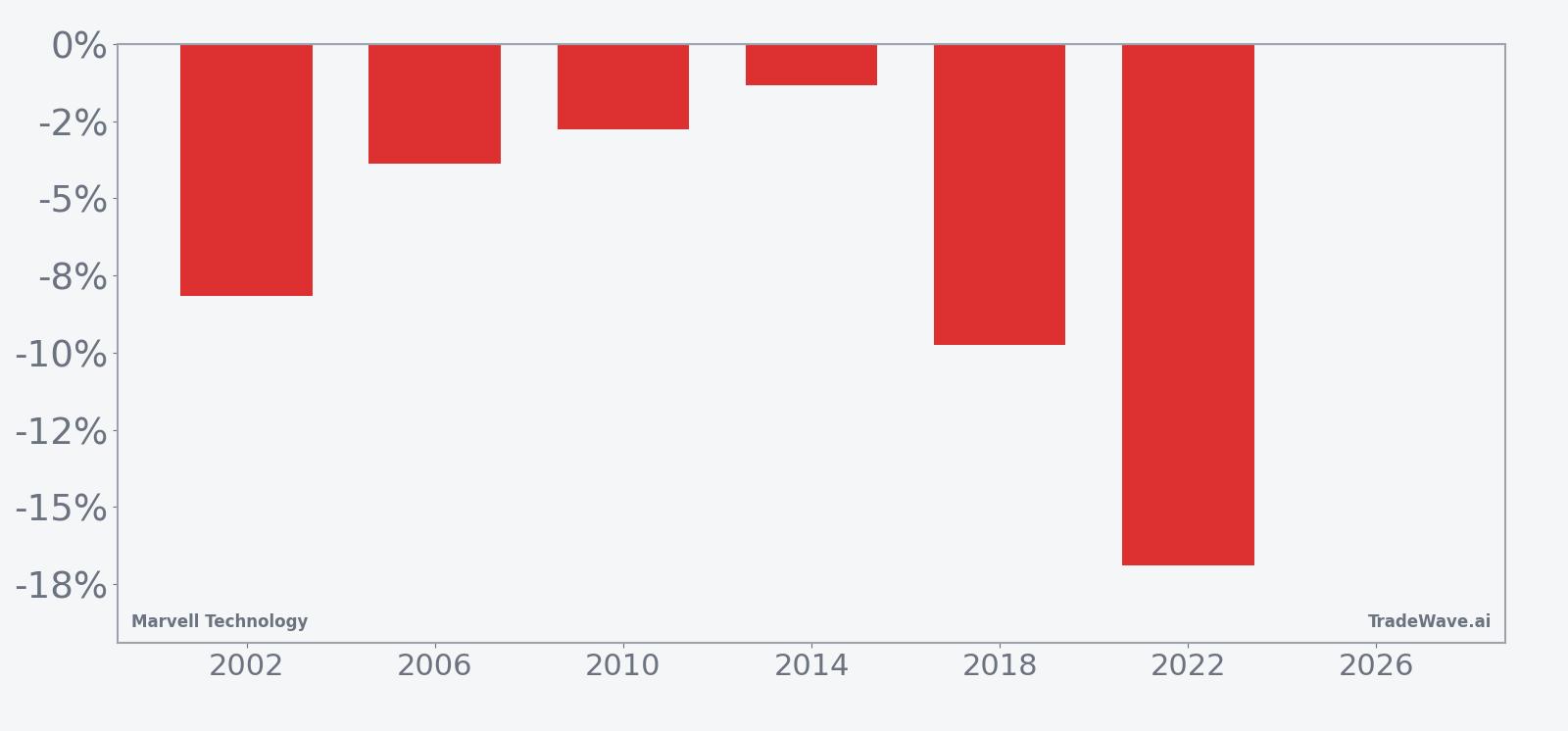
- Across the last 6 midterm election years, a 63-day window starting Mar 11 has produced 6 winning short setups in Marvell Technology, with an average profit of 7.13% for the short side.
- The pattern is explicitly short: every prior midterm-year iteration saw MRVL finish the window lower, even though several years included double-digit rallies at some point inside the stretch.
- Historical trades show large swings, with best intraperiod rallies of up to 21.4% against the short and worst drawdowns in favor of the short reaching about 24%.
- MRVL last closed at 89.57 after an 18.4% earnings surge, leaving it about 12.7% below its 52-week high and well above its 50-day moving average of 81.70.[2][5]
- Management-backed buybacks and insider buying, alongside a volume spike around earnings, add fuel to any move that develops inside this historically bearish midterm window.[2][3][5]
- Traders should treat this period as high-volatility rather than one-way: the TradeWave Ratio of 2.05 and a Sharpe ratio of 1.12 show meaningful travel in the trade direction but with sizable countertrend swings.
According to historical data from TradeWave.ai, this specific midterm-year stretch has behaved very differently from an average quarter for Marvell, and the next iteration is about to open again.
Seasonal window
Marvell Technology has fallen in all 6 midterm election years during this 63-day window, averaging 7.13% gains for the short side. The next run of that pattern begins on Mar 11, with the stock currently at 89.57 after a post-earnings jump that still leaves it about 12.7% below its 52-week high of 102.62.[2][5] Management has backed the rally with a $6 billion buyback plan and increased insider buying, while a volume spike around the earnings beat shows how quickly positioning can build when the narrative turns.[2][3][5] That mix of a historically bearish midterm window, a sharp AI-driven breakout and fresh corporate support sets up a tug-of-war that could define how this cycle plays out.
The pattern groups only midterm election years, so it compares Marvell’s behavior at the same point in the four-year political cycle rather than across random calendar years. That matters because midterm years often bring policy uncertainty, shifting fiscal priorities and tighter financial conditions, which can change how high-growth chip names trade around earnings and guidance.
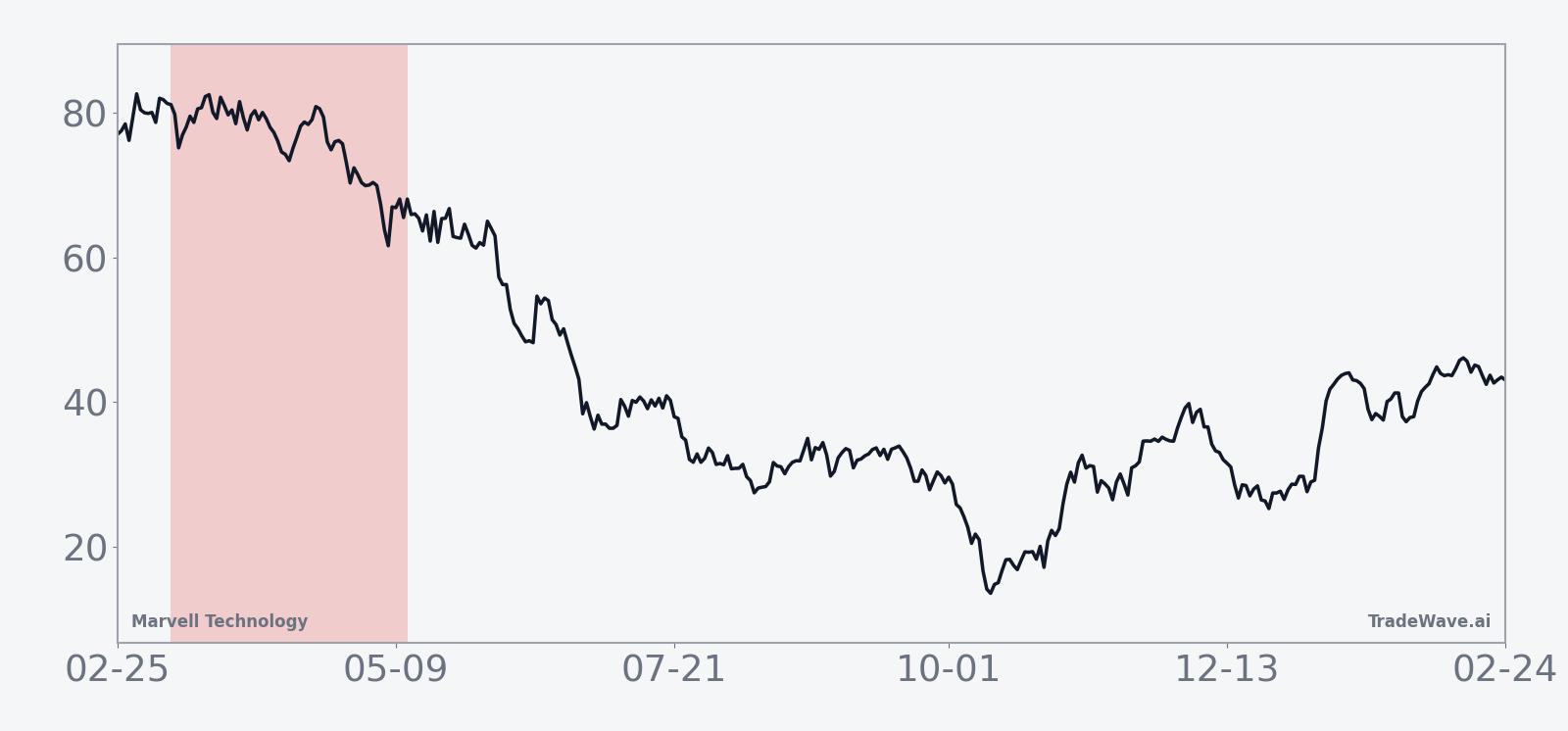
The historical seasonal trend line slopes steadily lower across the 63 days, which fits a short bias that tends to work over the full window rather than relying on a single air pocket. In several years the bulk of the move developed in the back half of the period, suggesting that early strength did not always invalidate the pattern.
A stacked view of net returns alongside best and worst intraperiod swings shows how much MRVL has typically moved inside this window.
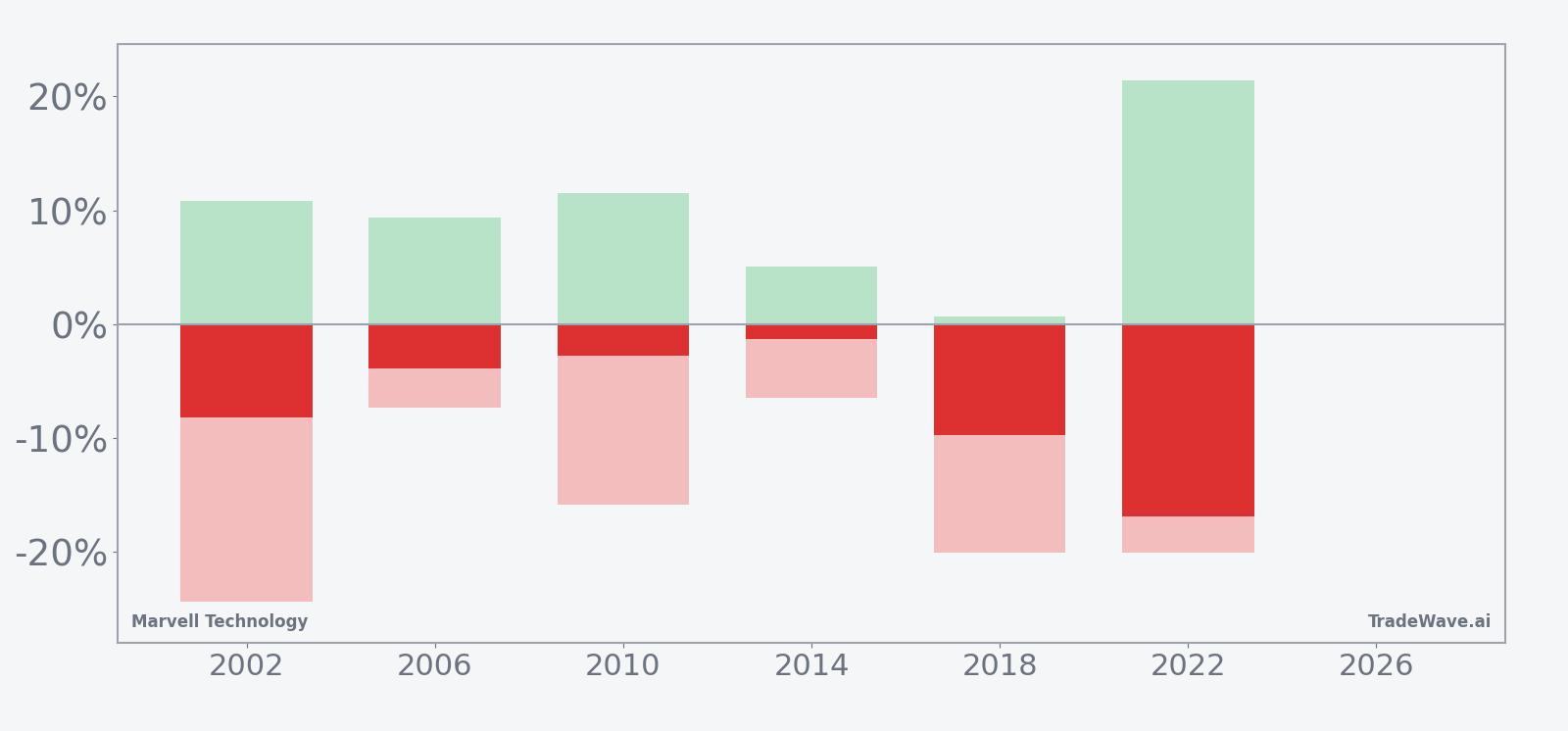
Per-year data underline how volatile this stretch has been. In 2022, for example, the short finished up 16.88%, yet the stock rallied as much as 21.4% at one point before rolling over, while the worst drawdown in favor of the short reached about 20.03%. In 2002 the net gain for the short was 8.15%, but the best intraperiod move against the position was 10.82% and the worst move in favor was roughly 24.36%. That mix of large maximum favorable and large maximum adverse excursions is what the TradeWave Ratio of 2.05 is flagging: this window has historically delivered meaningful travel in the trade direction, but with big countertrend swings along the way.
Across all six midterm years, the cumulative return for the short side is 50%, with a median profit of 6.02% and an annualized return of 7.0%. The Sharpe ratio of 1.12 suggests that, based on end-of-window outcomes, the risk-adjusted profile has been solid rather than spectacular, which fits a pattern that wins consistently but with sizable volatility inside the path. Add it up: six for six winning shorts, with enough intraperiod noise that timing and risk management have mattered as much as direction.
History does not guarantee future results, and even in windows where the short side ultimately won, adverse excursions against the trade have been large.
Price and near-term drivers
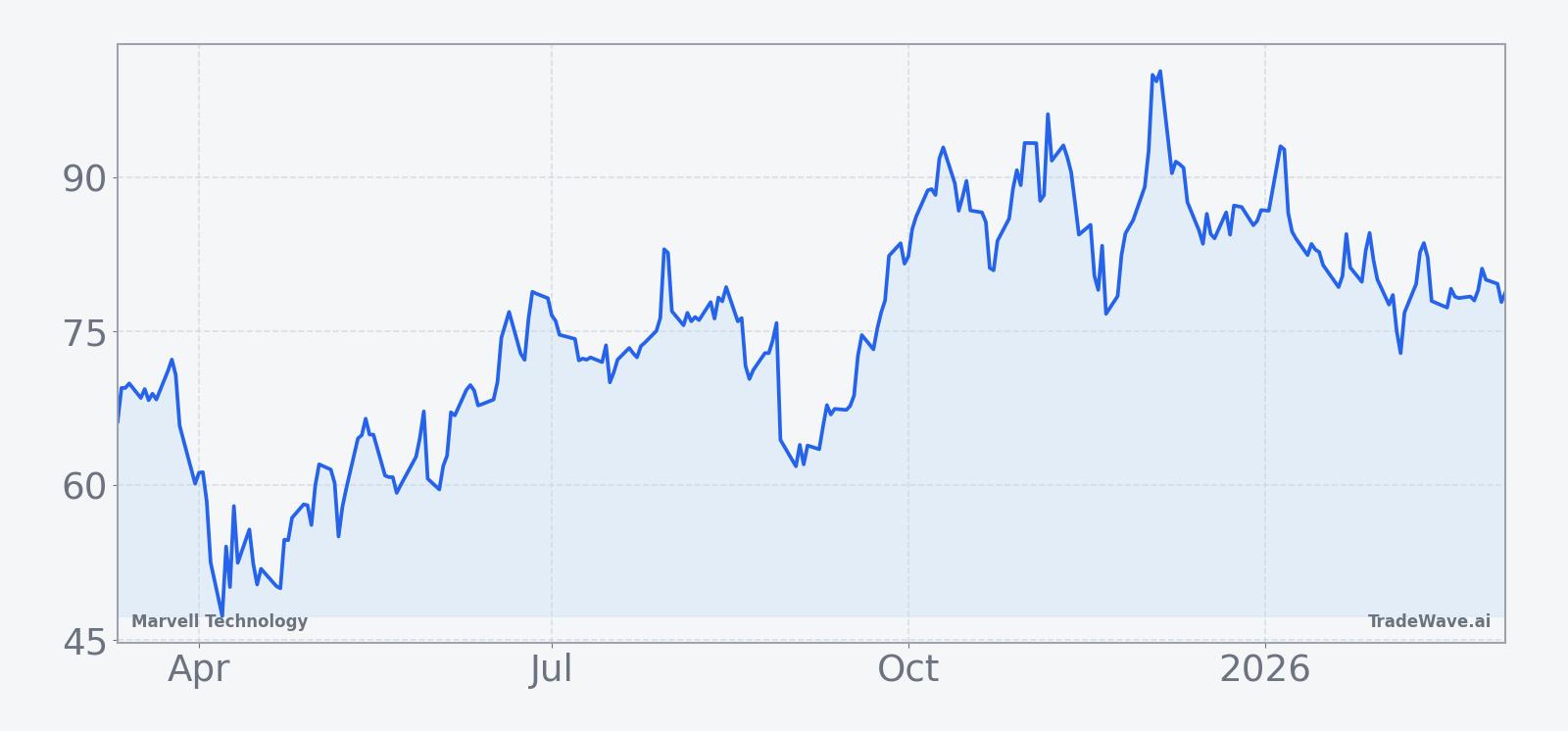
Marvell shares last closed at 89.57, up 18.4% on the day after the company beat fourth-quarter estimates and guided first-quarter revenue above Wall Street expectations, helped by robust AI infrastructure demand.[1][2][5][6] That surge leaves the stock about 12.7% below its 52-week high of 102.62 and well above both its 50-day moving average of 81.70 and its 52-week low of 46.77, with one-month performance at 3.38% and 20-day average volume of roughly 12.75 million shares.[2][5] The latest move came on heavy trading, with roughly 87.96 million shares changing hands as investors digested stronger guidance tied to custom AI chips and optical solutions for data centers.[1][2][5]
On Mar 5, Marvell reported fourth-quarter revenue of $2.22 billion, slightly ahead of the $2.21 billion consensus, and adjusted earnings of 80 cents per share versus expectations of 79 cents.[2][6] Management raised its first-quarter revenue forecast to $2.4 billion and outlined a path toward nearly $11 billion in fiscal 2027 revenue, with growth expected to accelerate each quarter as AI-related demand ramps.[1][2][6] The company also highlighted a $6 billion share repurchase authorization and increased insider buying, signaling confidence in the multi-year AI infrastructure story and providing a potential backstop on pullbacks.[1][3][5]
Macro and sector currents are working in Marvell’s favor for now. AI infrastructure spending remains a central theme across hyperscale data centers, with cloud providers racing to deploy custom accelerators and high-speed optical links.[1] Within semiconductors, that has translated into accelerating growth for hardware suppliers tied directly to AI workloads, a group that includes Marvell alongside larger peers in networking and compute.[1] The risk is that expectations have reset higher after the latest guidance, so any wobble in orders or a pause in cloud capex could hit richly valued AI beneficiaries harder than the broader chip complex.
The chart below situates the latest move in its recent multi-month context.
Election-cycle context and what to watch
Calendar-wise, markets are in the early part of the midterm election year, the phase that has often been choppier for growth stocks even when the broader four-year cycle remains constructive. For a name like Marvell that sits at the intersection of AI, data centers and high-multiple semis, that can mean sharper reactions to policy headlines around regulation, export controls or fiscal priorities tied to digital infrastructure. The historical pattern for this 63-day window captures exactly that backdrop across the last six midterm years, and it has leaned consistently in favor of lower prices by the end of the stretch.
What to watch from here comes down to three threads. First, earnings follow-through: whether hyperscale customers keep ramping AI infrastructure orders in line with Marvell’s upgraded outlook, or whether any sign of digestion creeps into commentary from cloud and chip peers in coming weeks.[1][2][6] Second, price behavior inside the window: if MRVL holds above its 50-day moving average and pushes back toward the 52-week high despite the historical midterm pattern, that would mark a clear break from prior cycles; if instead rallies fade and the stock starts carving out lower highs, it would look more like the six earlier midterm iterations.
Third, the Special Insight around positioning and corporate support bears watching. The recent volume spike and earnings-driven surge show how quickly investors can crowd into the AI story, while the $6 billion buyback and insider buying give management firepower to lean against weakness.[2][3][5] If heavy volume persists on up days and buyback activity appears to absorb dips, the seasonal short bias could face a tougher test than in past midterm years. If, on the other hand, volume dries up on rallies and spikes on down days, with little sign of support in the tape, the historical pattern of lower finishes for this window would be more in line with how the stock has traded in prior cycles.
Sources
- [1] Forbes, "Marvell Technology’s Path To AI Infrastructure Dominance", Mar 6, 2026
- [2] Reuters, "Marvell forecasts first quarter revenue above estimates", Mar 5, 2026
- [3] Seeking Alpha, "Marvell: Significant AI Win Coming Soon (Double Upgrade)", Oct 6, 2025
- [4] Seeking Alpha, "Marvell Stock Could Be A Marvellous Buy", Oct 5, 2025
- [5] MarketWatch, "Marvell’s stock rockets as data-center business demand grows", Mar 5, 2026
- [6] Barron's, "Marvell Earnings Beat Thanks to ‘Robust’ AI Demand", Mar 5, 2026
- [7] Forbes, "Should You Buy Marvell Technology Stock Today?", Dec 30, 2025
- [8] Reuters, "Marvell sinks as weak data center outlook stokes custom AI chip worries", Aug 29, 2025
- [9] Reuters, "Marvell shares jump as chipmaker bolsters AI ambitions with Celestial deal", Dec 3, 2025