Marvell Technology (MRVL) Has Dropped in All 6 Midterm Runs in This 63-Day Window
Marvell Technology is heading into a 63-day midterm-election seasonal stretch that has been consistently weak for the stock, even as shares trade well below their 52-week high.

Key takeaways
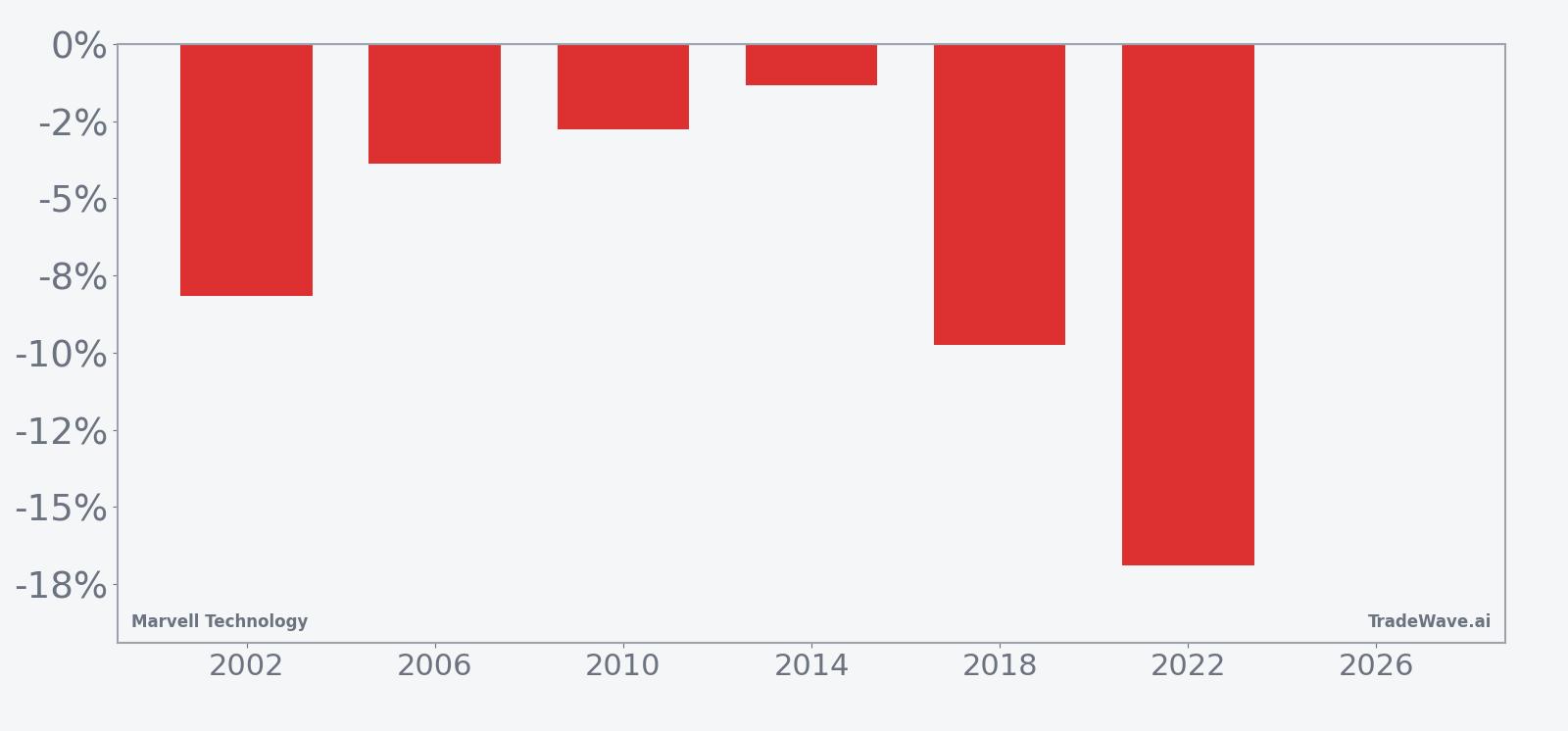
- Marvell Technology has declined in all 6 of the last midterm-election windows starting around Mar 11, with a short-side average gain of 7.13% over 63 trading days.
- The upcoming window runs from Mar 11 for roughly three months and is grouped across the last 6 midterm election years, not consecutive calendar years.
- The pattern is 100% profitable for short trades, with 6 winners and 0 losers, and a Sharpe ratio of 1.12 based on end-of-window outcomes.
- The TradeWave Ratio of 2.05 suggests price has typically traveled meaningfully in the trade direction within the window, independent of the final close.
- Intraperiod swings have been sharp, with historical best-case rallies for shorts but also sizeable adverse moves, underscoring elevated volatility risk.
- Shares trade at 79.05, about 22.9% below their 52-week high and down roughly 22% year to date, so this historically weak window would open against an already bruised tape.
According to historical data from TradeWave.ai, this specific midterm-election stretch has behaved very differently from an average spring for Marvell, and the next iteration begins in days.
Seasonal window
Marvell Technology has produced profitable short trades in all 6 midterm-election windows that start around Mar 11 and run for 63 trading days, averaging 7.13% gains for the short side. Shares closed Thursday at 79.05, leaving the stock about 22.9% below its 52-week high of 102.62 and roughly 22% lower year to date. That combination of a clean 6-for-6 short pattern and a stock already under pressure gives this upcoming window unusual weight for traders trying to time risk in one of the market’s key AI chip names.
The window sits in the midterm election year, a phase that often brings policy uncertainty, tighter financial conditions and choppier tape for growth stocks as Washington debates spending and regulation. Grouping results by this part of the presidential cycle matters because AI and semiconductor names like Marvell tend to trade as proxies for risk appetite and capital spending, which are especially sensitive to midterm-year swings in rates, fiscal policy and tech oversight.
Historically, this 63-day stretch has been a cleanly negative period for Marvell’s share price, which is exactly what a short pattern wants to see. Across the last 6 midterm election years in the sample, every iteration delivered a profitable outcome for shorts, with net returns ranging from about 1.3% to 16.9% in favor of the trade. The average profit of 7.13% reflects that consistency, while the median outcome of 6.02% shows that the typical year has not required catching an outlier to work.
The per-year table shows 2022 as the strongest short year, with a net return of 16.88% for the trade and a maximum favorable move of 21.4% from entry before the window closed. At the other end of the spectrum, 2014 still finished as a winner for shorts but with a modest 1.33% net gain and a relatively contained worst drawdown of 6.44% from the entry price. Even the softer years have not flipped into outright losses for this setup.
Intraperiod swings have been anything but gentle. In 2002, for example, the short trade finished up 8.15% but endured a maximum adverse move of 24.36% against the position at one point, meaning the stock rallied sharply before rolling over. In 2018, the worst drawdown from entry was 20.05% even though the short ultimately gained 9.76%. That pattern of large best-case and worst-case excursions is what the TradeWave Ratio of 2.05 is flagging: price has tended to move meaningfully in the trade direction at some point during the window, but not without sizable countertrend rallies along the way.
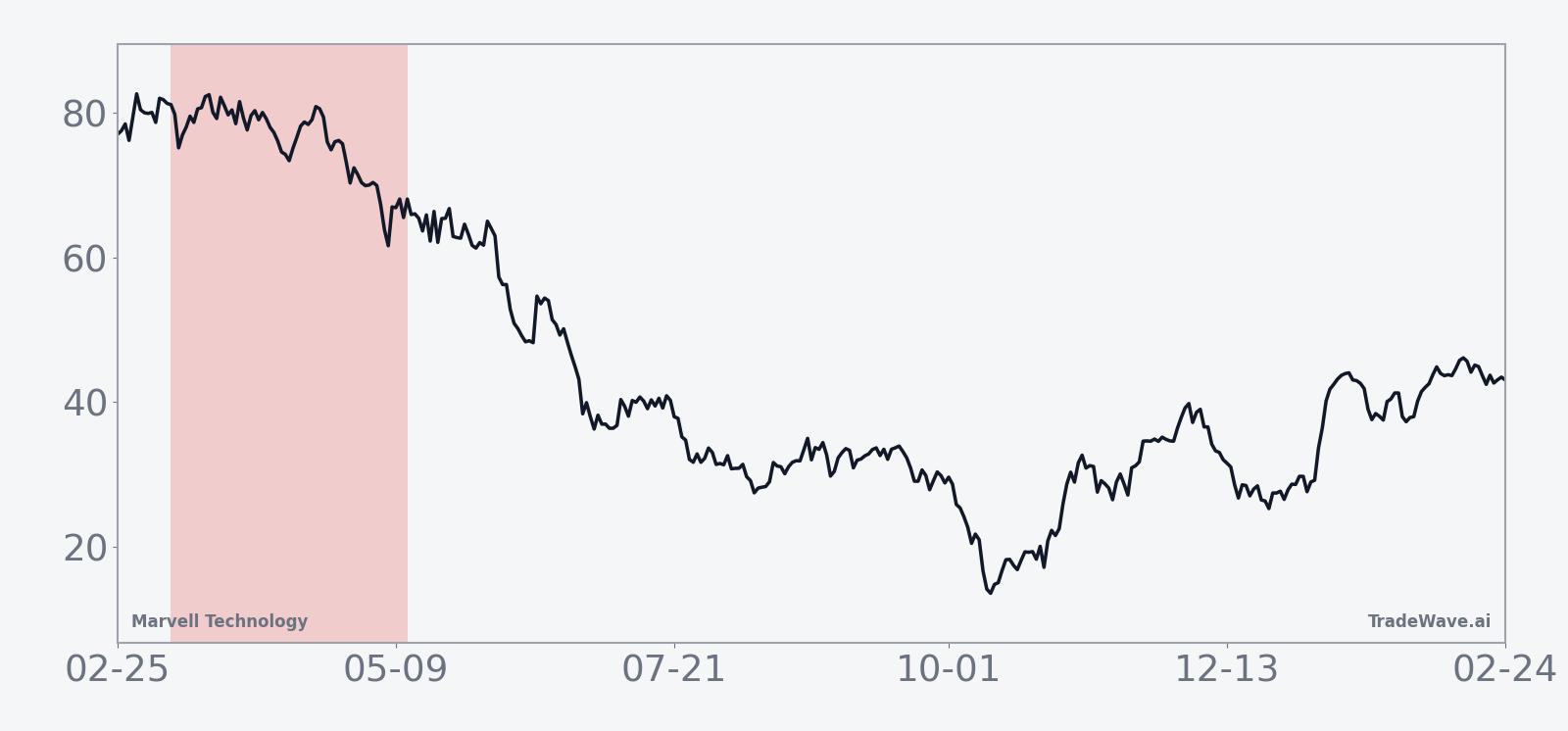
The historical seasonal trend line slopes steadily lower for most of the window, with the bulk of the short-side gains accruing in the middle third of the period rather than in a single sharp break. That suggests prior midterm years have often seen Marvell grind lower over several weeks, punctuated by rallies that have tended to fade rather than reverse the pattern.
A closer look at yearly net returns and intraperiod swings shows how often shorts have been rewarded despite sizable countertrend moves.
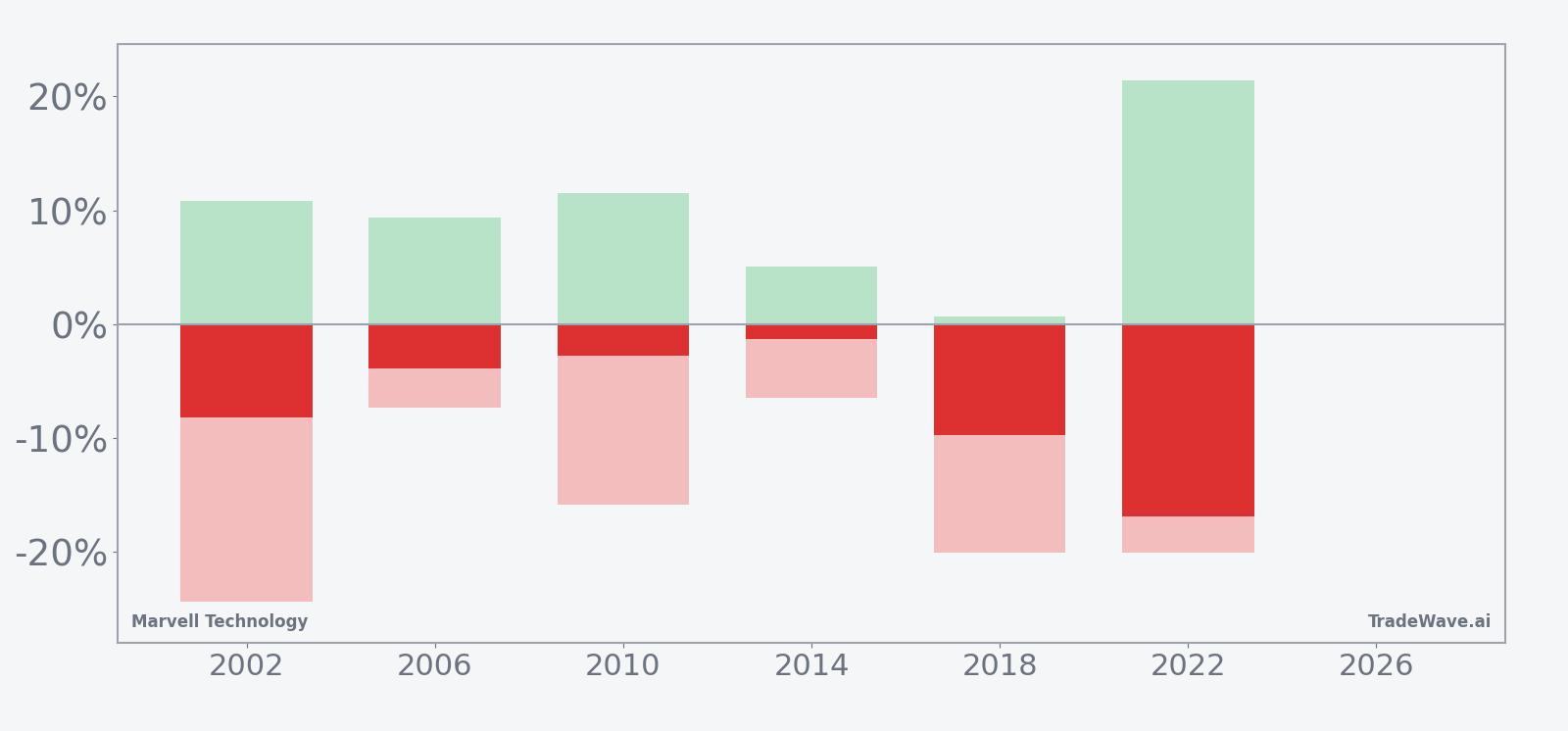
The combined net, best-case and worst-case bars show a clear pattern: every year has delivered meaningful downside at some point for shorts, but several have also featured double-digit rallies against the position before the trade ultimately worked. Add it up and you get a 6-for-6 record for the short side, but with volatility that demands respect.
History does not guarantee future results; adverse excursions can be large even in winning windows, and traders can be forced out of positions before the historical pattern plays out.
Price and near-term drivers
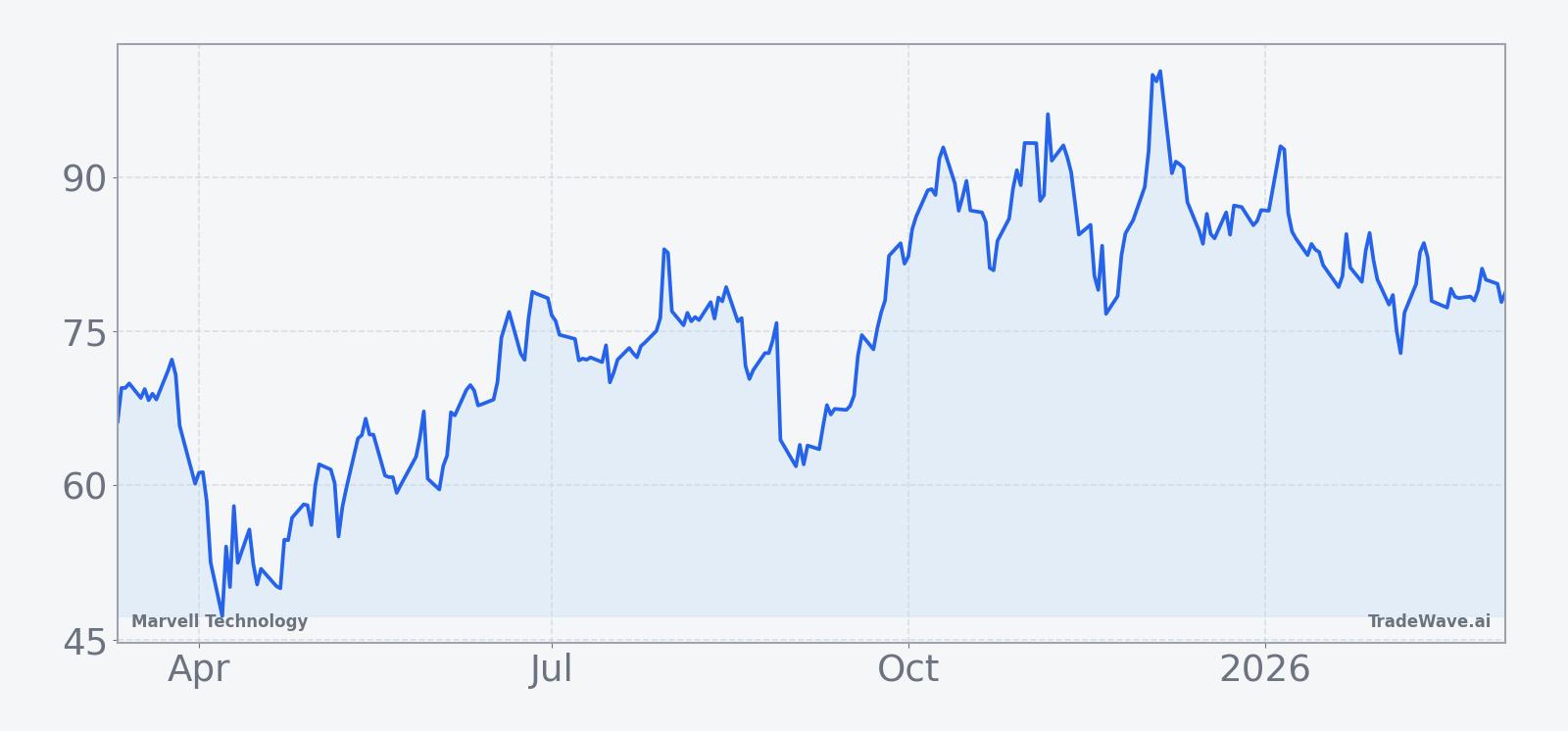
Marvell closed at 79.05 on Thursday, up 1.23% on the day, extending a modest one-month gain of 3.38% but still sitting about 22.9% below its 52-week high of 102.62 and just above a 52-week low near 46.77. The stock trades slightly below its 50-day moving average of 81.70 and on lighter-than-normal volume of about 4.5 million shares versus a 20-day average near 12.75 million, a sign that the latest bounce has not yet attracted heavy conviction buying.
In 2025, Marvell’s story was dominated by AI infrastructure and data center demand, with investors focused on how quickly custom AI chip programs could scale into revenue. In October 2025, one analysis highlighted strong Q2 results driven by data center growth and pointed to significant insider stock purchases as a sign of management’s confidence in long-term value, even as guidance hinted at near-term margin pressure.[1] Later that year, coverage emphasized the company’s strategic shift toward higher-margin AI solutions and the potential for custom accelerators to reshape its revenue mix.[2]
Corporate actions have reinforced that pivot. In October 2025, one report described a “significant AI win” tied to Microsoft’s ramp-up of custom AI chip production, with the potential to push Marvell’s fiscal 2026 revenue toward $10.5 billion.[3] In December 2025, Reuters detailed Marvell’s $3.25 billion acquisition of photonics specialist Celestial AI, noting that shares jumped as investors cheered the move to bolster AI ambitions and expand the company’s footprint in data center optics.[4] On the same day, CNBC highlighted Marvell among stocks making big midday moves after the company reported Q3 earnings of 76 cents per share on $2.08 billion in revenue, topping expectations and sending the stock sharply higher.[5]
Not every headline has been upbeat. In August 2025, Reuters reported that Marvell shares sank after management flagged a weaker data center outlook tied to irregular custom AI chip sales, stoking worries that the AI boom might not translate into a smooth revenue ramp.[6] Earlier in March 2025, Bloomberg noted that the stock fell when a growth forecast, while roughly in line with average estimates, trailed the loftiest expectations amid intense enthusiasm for AI plays.[7] Those episodes underline how quickly sentiment can swing around this name when guidance or demand visibility wobbles.
The chart below situates the latest move in its recent multi-month context.
Stepping back, Marvell sits at the intersection of two powerful forces: the AI infrastructure boom and the policy and rate backdrop of the midterm election year. A December 2025 macro overview framed the company as a beneficiary of growing AI and data center demand, with custom AI chips already in production and a sector-wide shift toward higher-margin AI solutions.[2] As the calendar moves deeper into the midterm year and closer to the pre-election phase, investors will be weighing that structural AI tailwind against a seasonal window that has historically favored the short side for this stock.
What to watch as the window opens
The next iteration of this 63-day midterm-election window begins on Mar 11, so the near-term focus is on how Marvell trades into and through that date. A sustained move back above the 50-day moving average with rising volume would signal that buyers are willing to lean into the AI story despite the historical pattern, while a failure to hold the high 70s could indicate that the familiar midterm-year pressure is starting to reassert itself.
On the macro and policy side, traders will be watching for any shifts in rate expectations, fiscal spending debates and regulatory rhetoric around AI and data centers, all of which tend to be more fluid in midterm years. Stronger-than-expected AI capex updates from hyperscalers or new design wins could blunt the seasonal tendency, while cautious guidance or delays in custom chip ramps could reinforce it.
Inside the window, behavior around sharp rallies will matter as much as the direction of travel. Historically, several of the best short years featured double-digit squeezes against the position before the trade ultimately worked, so a fast spike higher would not automatically contradict the pattern. What would challenge it is a rally that holds and builds on heavy volume, rather than fading back into the kind of grinding weakness that has characterized prior midterm cycles.
For a stock that has already given back a large chunk of its AI premium, the message from the seasonal data is not a prediction but a warning label: this particular slice of the midterm year has repeatedly been a rough stretch for longs in Marvell. How the stock behaves as Mar 11 approaches, and whether AI-driven catalysts can overpower that history, will tell traders whether this cycle is finally the exception.
Sources
- [1] Seeking Alpha, "Marvell Stock Could Be A Marvellous Buy" (Oct 5, 2025).
- [2] Forbes, "Should You Buy Marvell Technology Stock Today?" (Dec 30, 2025).
- [3] Seeking Alpha, "Marvell: Significant AI Win Coming Soon" (Oct 6, 2025).
- [4] Reuters, "Marvell shares jump as chipmaker bolsters AI ambitions" (Dec 3, 2025).
- [5] CNBC, "Stocks making the biggest moves midday" (Dec 3, 2025).
- [6] Reuters, "Marvell sinks as weak data center outlook" (Aug 29, 2025).
- [7] Bloomberg, "Marvell Declines After Growth Forecast Trails Estimates" (Mar 5, 2025).