Netflix (NFLX) Has Finished This 18-Day March Window Higher in 9 of the Last 10 Years
Netflix is sprinting higher into an 18-day March stretch that has usually rewarded longs, setting up a clash between hot price action and a powerful seasonal tailwind.

Seasonal window
Netflix has finished this upcoming 18-day March window higher in 9 of the past 10 years, with winning years averaging gains of 5.43%. Shares closed Monday at $96.24, up 13.8% on the day and trading above their 50-day moving average of $86.35, after a sharp rebound from post-earnings weakness.[1]
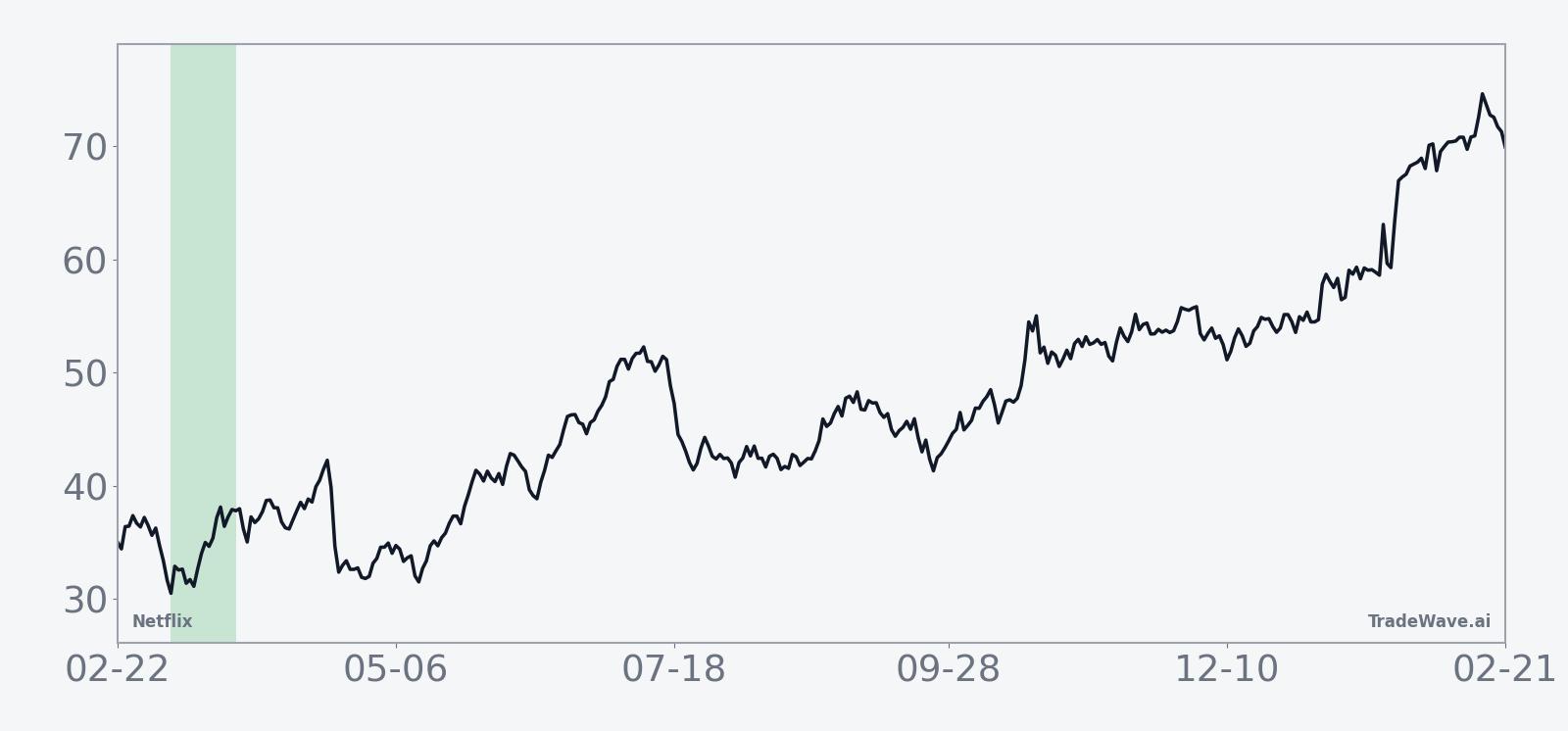
This seasonal window begins on Mar 8 and spans 18 trading days. The trade direction is long, and across the last decade Netflix has posted a positive net return in 90% of these windows, with 9 winners and just 1 loser. Average profit in the winning years is 5.43%, while the average across all ten years, including the lone losing stretch, comes in at 5%.
The strongest year in the sample was 2025, when Netflix gained 15.07% during this exact window, with a best intraperiod run-up of 15.23% from the entry price of $86.67 before settling near $99.73 at the close. The weakest outcome was 2020, which delivered a net loss of 1.18% even though the stock at one point traded 7.63% above the entry before reversing to a worst drawdown of 16.23% from that starting level.
The historical path of returns inside the window tends to show gains building rather than spiking and fading. In several years, including 2019, 2022 and 2025, the maximum favorable move arrived after an early consolidation, suggesting that rallies often accelerate in the back half of the window rather than on day one. That pattern aligns with the trend metrics, which show a 70 to 30 tilt toward long-side strength across the full window and a still-positive 60 to 40 bias when focusing on the early portion.
Intraperiod swings have been meaningful. Maximum favorable excursions, the best point-to-peak moves from entry, have ranged from about 4.88% in 2024 to more than 13% in 2022 and 15% in 2025. Maximum adverse excursions, the worst drawdowns from entry, have at times been shallow, such as 0.12% in 2019 and 0.74% in 2021, but in tougher years like 2018 and 2023 the stock traded 5.25% and 8.49% below entry at the worst point before recovering into a positive close.
The TradeWave Ratio (TWR) for this pattern stands at 2.38, which means price has typically traveled meaningfully in the trade direction within the window, independent of where it finished. The Sharpe ratio of 1.0, based on end-of-window outcomes, points to a historically favorable risk-adjusted profile for this specific slice of the calendar compared with a flat seasonal backdrop.
On a cumulative basis, stacking each year’s net return across the decade produces a 58% total gain for this window, or an annualized return of 4.68%. Add it up: a long-only approach applied just to this 18-day March stretch would have compounded meaningfully over the last ten years, even with the 2020 drawdown in the mix.
Year-by-year bars of net returns, best run-ups and worst drawdowns show how often the window has rewarded longs and how deep the setbacks have been.
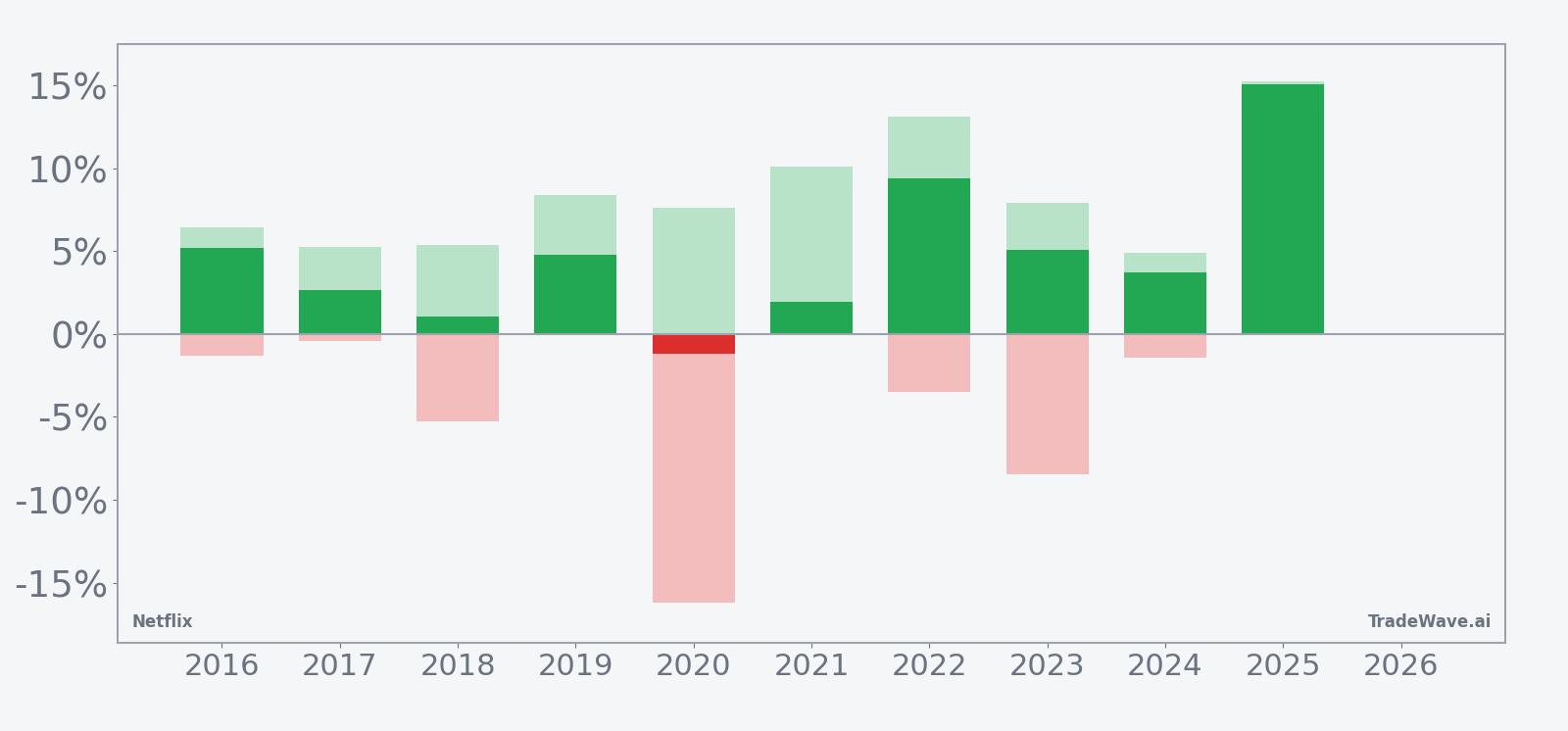
History does not guarantee future results, and the worst intraperiod drawdowns in this window have at times exceeded 10% even in years that finished higher.
For traders, the headline is simple: nine for ten with a positive all-years average and a track record of sizable upside swings. The catch is that when this window has gone wrong, it has done so through sharp, fast drawdowns rather than quiet drift.
Key takeaways
- Netflix is approaching an 18-day March window starting Mar 8 that has finished higher in 9 of the past 10 years.
- Winning years in this stretch have averaged gains of 5.43%, while the all-years average, including the lone loser, is 5%.
- The pattern is long-biased, with a 90% win rate and a TradeWave Ratio of 2.38, pointing to meaningful intraperiod moves.
- Maximum favorable moves have often topped 7% to 10%, but the worst drawdowns have reached more than 16% in the weakest year.
- Netflix just jumped 13.8% to $96.24, trading above its 50-day moving average as it heads into this historically strong window.[1]
- History shows upside has usually won out in this slice of the calendar, but the path has not been smooth.
According to historical data from TradeWave.ai, this specific March stretch has behaved very differently from an average month on the Netflix calendar, and the next iteration is only days away.
Price and near-term drivers
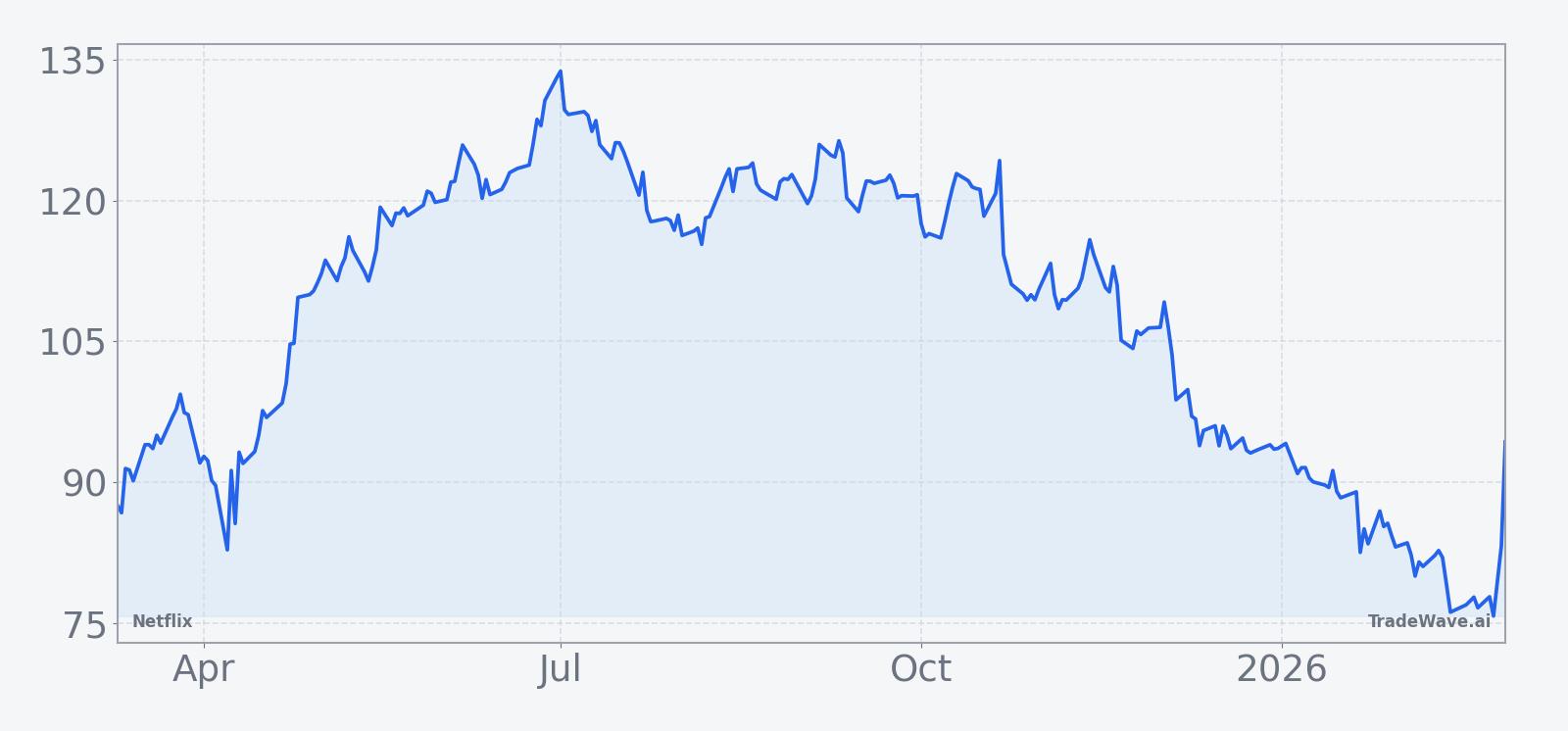
Netflix closed Monday at $96.24, up 13.8% on the session, extending a roughly 15.73% gain over the past month and pushing well above its 50-day moving average of $86.35.[1] The move follows a choppy stretch after fourth-quarter results that left parts of Wall Street underwhelmed on guidance and subscriber momentum, even as the company continued to lean into advertising and new content bets.[1]
In January, Netflix’s fourth-quarter report drew a mixed reaction as analysts weighed solid headline numbers against a softer tone on the outlook and questions about how quickly ad-supported tiers and password-sharing crackdowns would translate into durable earnings power.[1][2] Ahead of that release, expectations had centered on a modest step-up in revenue and earnings, driven by international subscriber growth and early advertising traction.[4]
Looking back to October 2025, Netflix’s third-quarter earnings underscored how one-off items can still dominate the narrative. The company reported earnings per share of $5.87 versus estimates of $6.97 after absorbing a $619 million tax expense tied to a dispute in Brazil, even as revenue landed in line at $11.5 billion.[6] Shares fell 6.3% in the immediate aftermath, a reminder that downside volatility can flare quickly when expectations are tight.[6]
Management has guided Q4 2025 revenue to about $12.0 billion with earnings per share near $5.45, and has sketched out full-year 2026 revenue around $51.6 billion with EPS near $3.24.[1][4] Those figures frame a company still in investment mode, balancing heavy content and technology spending against the need to show operating leverage as the streaming market matures.
On the Street, Netflix remains a Buy-rated name, with a consensus price target around $124.80 from firms including KeyBanc and Wedbush, according to compilations from CNBC and Yahoo Finance.[1][4][5] That target sits comfortably above Monday’s close, though some of the underlying calls date back to late 2025 and reflect a different price regime and deal backdrop, including reaction to Netflix’s announced acquisition of Warner Bros.’ film and streaming assets.[5]
Sector-wide, Netflix is still navigating a streaming landscape where attention spans are fragmenting and rivals are fighting for the same subscription and ad dollars. In October 2025, Reuters highlighted how investors were focused on the payoff from Netflix’s push into advertising and gaming as they looked for new growth engines beyond traditional streaming subscriptions.[12] Competitive pressure from legacy media and tech platforms has not eased, which makes each earnings season and each guidance tweak a fresh referendum on the strategy.
The chart below situates the latest surge in the context of Netflix’s past year of trading.
Macro and streaming backdrop
Netflix’s growth story is increasingly tied to broader market dynamics around digital advertising and consumer engagement. As ad budgets rotate toward connected TV and performance-based formats, the company’s ad-supported tiers sit at the intersection of brand and direct-response spending, a position that can amplify both upside in strong markets and downside when marketers pull back.[1]
At the same time, the streaming industry is wrestling with saturation in mature markets and the reality that consumers are juggling multiple services. Reuters has noted that Netflix’s bets on advertising and gaming are central to its effort to keep users engaged and reduce churn as competition intensifies.[12] Those initiatives are capital-intensive and take time to scale, which is why investors scrutinize every data point on engagement and ad load.
Macro conditions also matter for valuation. Higher-for-longer interest rates tend to compress multiples on long-duration growth stories, while any sign of easing can quickly re-rate names like Netflix that sit at the crossroads of tech and media. That macro sensitivity adds another layer of volatility on top of the company’s own execution risk.
Valuation and positioning into the window
After a powerful rally off its 52-week low of about $8.21, Netflix is still trading roughly 16.5% below its 52-week high near $115.25, based on recent price context.[1] That leaves room on the upside if sentiment continues to heal, but also underscores how far the stock has already come in this cycle.
In July 2025, Bloomberg flagged that Netflix was at risk of an earnings letdown after a roughly $250 billion rally in market value, highlighting how quickly expectations can outrun fundamentals in this name.[10] Later that year, Yahoo Finance reported that retail investors were loading up on the stock after a $40 billion selloff, a sign that dip-buying appetite remained strong even as volatility picked up.[11]
Analysts and investors are now trying to square that history of boom-and-bust sentiment with the company’s more measured guidance path and the looming seasonal window. The key question is not whether Netflix can still surprise, but how much of the next leg of growth is already priced into a stock that has been both a market darling and a laggard at different points over the past 18 months.[1][9]
What to watch as the March window opens
With the March 8 seasonal window approaching, traders will be watching how Netflix behaves around a few key catalysts and levels. First, the $96 to $100 zone that capped the stock in prior rallies now sits just below the 52-week high region, and price action there will show whether buyers are willing to press the advantage into a historically strong stretch.
Second, intraperiod behavior will matter as much as the final outcome. In prior years, the best runs in this window often followed brief pullbacks, with maximum adverse moves of several percentage points before the stock turned higher. If Netflix sells off 5% to 8% early in the window and then stabilizes, that would be consistent with the historical pattern of choppy starts followed by stronger finishes.
Third, earnings revisions and commentary around advertising, gaming and any potential Warner Bros. integration will shape how much fundamental fuel is available for seasonal tailwinds.[1][5][12][13] A supportive macro backdrop for ad spending and a steady tone on subscriber engagement would give bulls more confidence that any seasonal strength is riding on more than just calendar effects.
Finally, watch volume and volatility. The 6.3% post-earnings drop in October 2025 showed how quickly sentiment can flip when expectations are tight and news disappoints.[6] If this March window delivers another outsized move, whether up or down, it is likely to come with a spike in trading activity as both long-only investors and short-term traders react to a stock that has a history of moving fast when the calendar and the news flow line up.
History does not dictate what happens next, but it does set the stage: Netflix is heading into one of its most consistently positive 18-day stretches of the year with momentum already at its back. How the stock trades through that window will tell investors whether this cycle is rhyming with the last decade or breaking the pattern.
Sources
- [1] CNBC, "Netflix's fourth-quarter results left the Street disappointed" (Jan 21, 2026).
- [2] The Wall Street Journal, "Netflix Stock Drops After Streamer Posts Strong Earnings, Muted Outlook" (Jan 21, 2026).
- [3] The Motley Fool, "Is Now the Time to Buy Netflix Stock?" (Oct 24, 2025).
- [4] Yahoo Finance, "Netflix About To Report Q4 Earnings -- Here's What To Expect" (Jan 16, 2026).
- [5] CNBC, "Netflix gets a downgrade after announcing Warner Bros. film and streaming acquisition" (Dec 8, 2025).
- [6] Reuters, "Netflix misses earnings targets after tax dispute in Brazil" (Oct 21, 2025).
- [7] Forbes, "What Could Turn Netflix Into Wall Street’s Hot Pick?" (Nov 12, 2025).
- [8] Barchart.com, "Netflix Drops Post Q3 Earnings. Is NFLX Stock Trading at a Bargain?" (Oct 22, 2025).
- [9] CNBC, "Netflix is missing out on the market's latest run" (Oct 9, 2025).
- [10] Bloomberg, "Netflix Is at Risk of Earnings Letdown After $250 Billion Rally" (Jul 17, 2025).
- [11] Yahoo Finance, "Retail Crowd Is Loading Up on Netflix After $40 Billion Selloff" (Dec 11, 2025).
- [12] Reuters, "Netflix's ad, gaming bets in focus as investors seek clarity on pay-off" (Oct 21, 2025).
- [13] Reuters, "Exclusive: Netflix taps bank to explore bid for Warner Bros Discovery" (Oct 30, 2025).
- [14] Reuters, "Netflix shares fall as weak dollar-driven forecast fails to impress" (Jul 18, 2025).