Colgate-Palmolive (CL) Has Gained in 14 of 15 Years in This 30-Day Spring Window
Colgate-Palmolive is heading into a historically strong 30-day spring stretch just as the stock trades lower for 2026, putting a rare seasonal tailwind on the radar for a defensive staple.

Seasonal window
Colgate-Palmolive has posted gains in 14 of the past 15 years during a 30-day window that begins on Mar 17, with winning years averaging 3.75% returns. The stock closed Monday at 97.30, down 1.9% on the day and roughly 2.0% below its 52-week high of 99.33, while sitting about 12% lower for 2026 so far.[3] That combination of a soft tape and a historically strong spring pattern gives traders a clean line of sight on a potential shift in tone later this month.
Key takeaways
- A 30-day window starting Mar 17 has been strongly bullish for Colgate-Palmolive, with 14 winners and 1 loser over the past 15 years.
- Percent Profitable sits at 93%, with winning years averaging 3.75% gains and all years averaging 3% including the lone loss.
- The pattern is aligned with a long trade direction, and the TradeWave Ratio of 1.82 points to meaningful intraperiod travel in the upside direction.
- Historical best-case moves show solid upside bursts, but adverse excursions have occasionally been sharp, including a double-digit drawdown in 2020.
- Colgate-Palmolive enters this window after a 12% year-to-date decline, leaving the stock just under 2% below its 52-week high despite recent weakness.[3]
- Investors watching this window should balance the strong win rate against the fact that intraperiod downside has sometimes been larger than the final gains.
According to historical data from TradeWave.ai, this specific late-March window has behaved very differently from an average month on the calendar, and the next iteration is about to open.
How the spring pattern has behaved
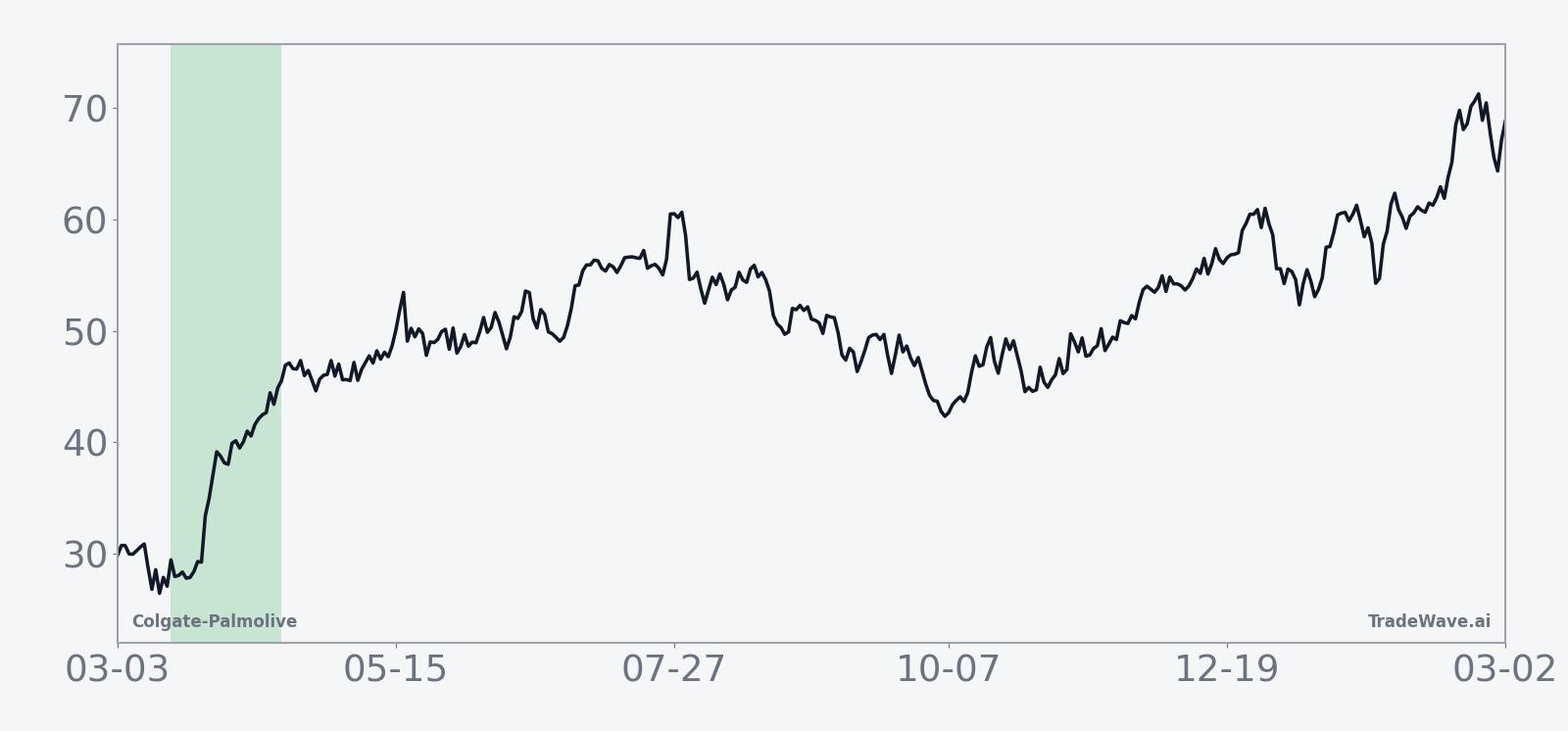
This seasonal window begins on Mar 17 and spans 30 trading days. Historically, during this period, Colgate-Palmolive has tended to grind higher in a relatively consistent way, with a clear bias in favor of long positions.
The trade direction for this pattern is long, and the track record is unusually strong. Percent Profitable is 93%, with 14 winning years and just 1 losing year across the 15-year lookback. In the winning years, Colgate-Palmolive has gained an average of 3.75% from entry to exit, while the average across all years, including the single loss, comes in at 3%.
Median profit of 3.49% sits close to the average, which suggests the distribution of outcomes has not been dominated by a single outlier year. The cumulative return across all 15 windows is 63%, and the annualized return for this pattern is 3.31%, which is notable for a slice of the calendar that covers only 30 trading days each year.
Volatility inside the window has been manageable but not trivial. The standard deviation of end-of-window returns is 2.38%, and the Sharpe ratio, a risk-adjusted measure of average return, stands at 1.27. The TradeWave Ratio (TWR) is 1.82, which reflects how far price typically travels in the trade direction within the window regardless of the final close, hinting that intraperiod swings can be larger than the net result.
Individual years show how that plays out. In 2021, the stock gained 6.15% during the window, with a maximum favorable move of 6.54% and a relatively shallow worst drawdown of 1.49% from the entry price. In 2020, by contrast, the window still finished higher by 3.49%, but the worst intraperiod drawdown reached 16.68% before the stock recovered, underscoring that even winning years can involve uncomfortable downside.
The lone losing year in the sample is 2024, when Colgate-Palmolive fell 2.38% over the window. That year still saw a maximum favorable move of 2.38% before reversing, and the worst drawdown from entry was 2.93%, which is modest compared with the 2020 shock but a reminder that the pattern is not bulletproof.
Looking across the per-year profile, the strongest runs have tended to cluster in the early 2020s, with 2021, 2022 and 2023 all delivering gains between roughly 4.85% and 6.5% and maximum favorable moves that pushed even higher. Earlier years such as 2016 and 2017 were quieter, with net returns closer to flat to low single digits and smaller intraperiod swings.
The 15-year seasonal trend chart for this window shows a steady upward slope rather than a sharp spike. The typical pattern is a gradual build in gains through the middle of the window, with some tendency for returns to consolidate toward the end rather than accelerating into the close.
A second view that layers in best and worst intraperiod moves highlights how upside bursts and drawdowns have coexisted inside this window.
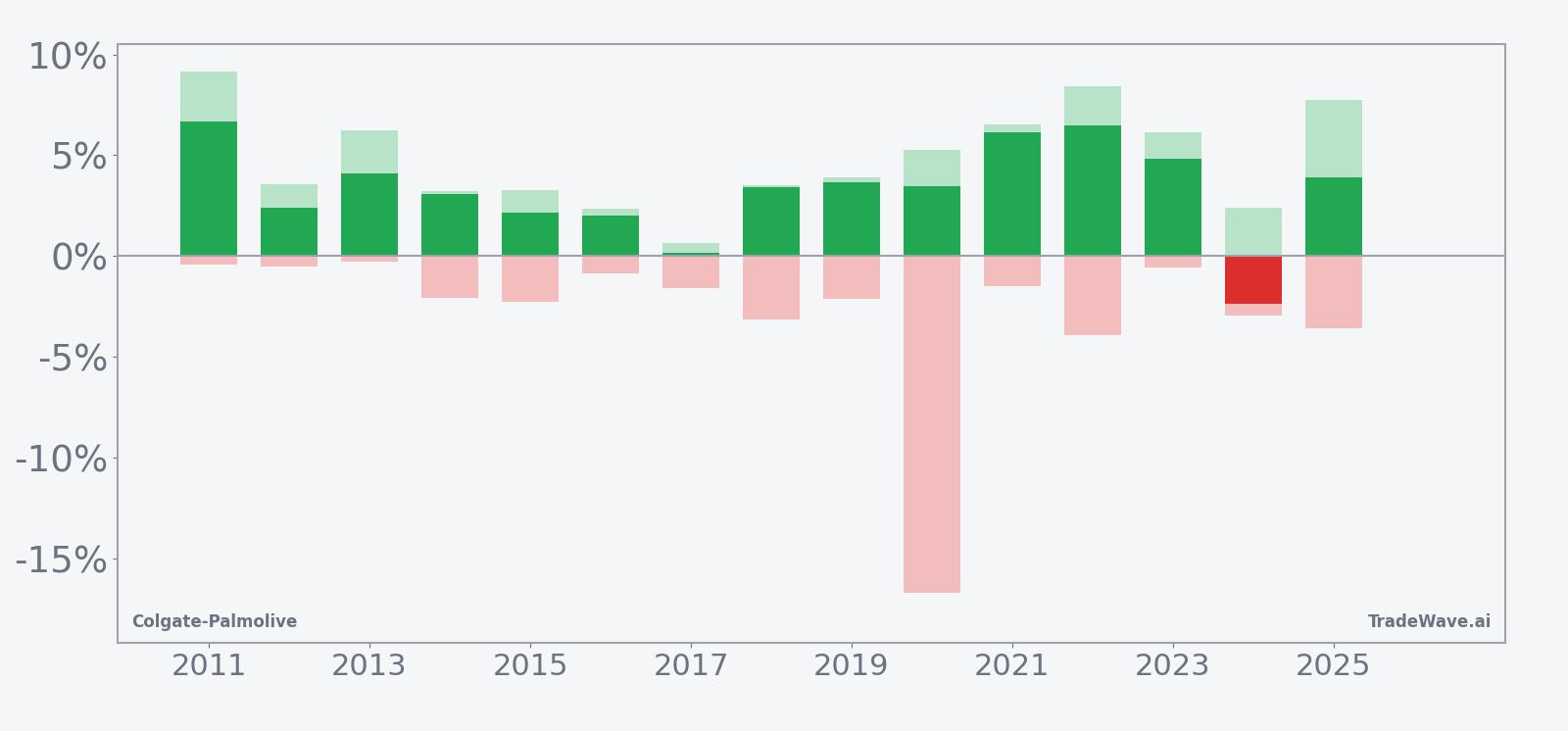
Viewed through that lens, the pattern looks like a classic “grind higher with pockets of stress” setup. Most years show positive net returns with maximum favorable moves that extend several percentage points above the final close, while maximum adverse moves are usually contained but occasionally spike, as in 2020. The key takeaway is simple: the window has favored longs in 14 of 15 years, but the path to those gains has not always been smooth.
History does not guarantee future results, and adverse excursions can be large even in winning windows, so traders should treat this pattern as context rather than a forecast.
Price and near-term drivers
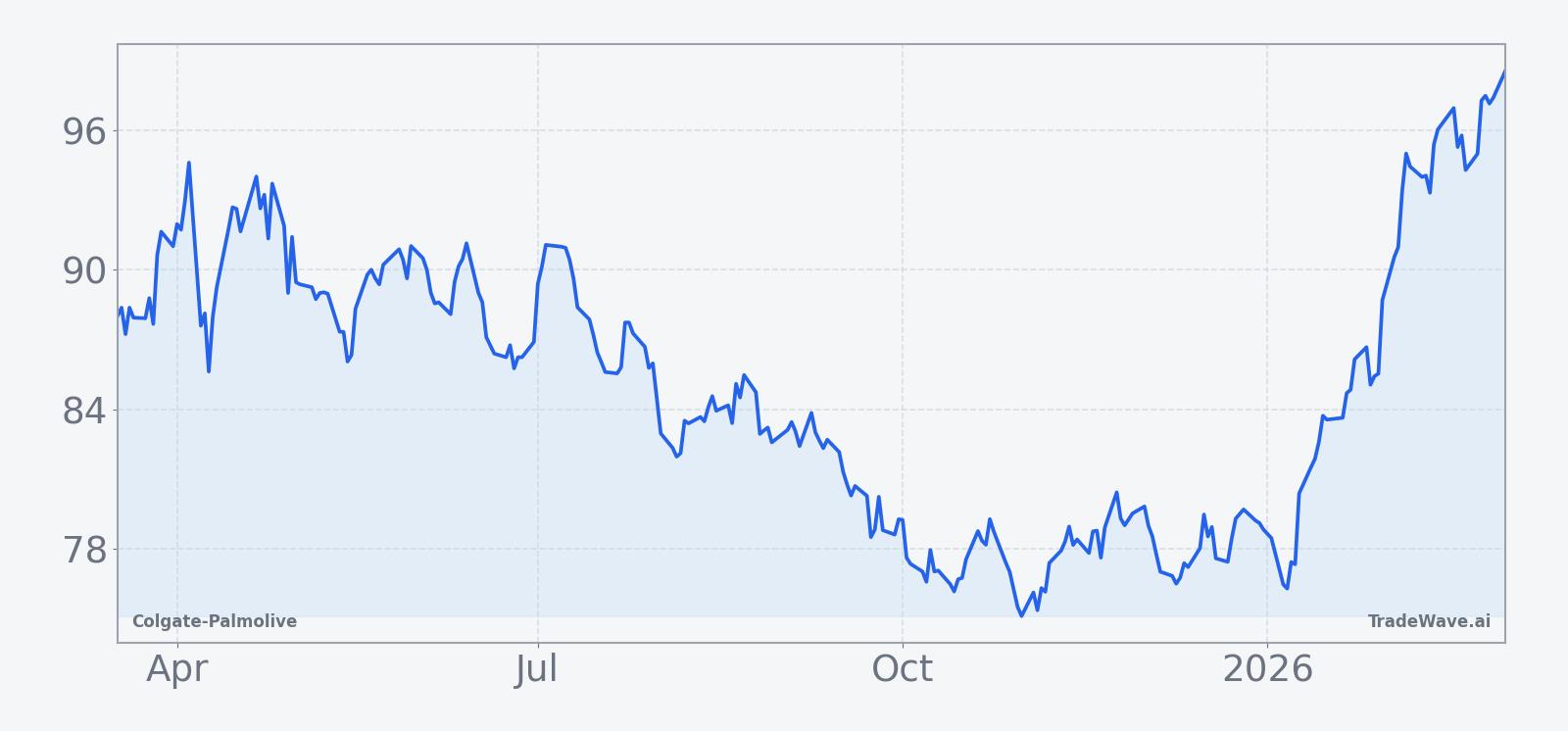
Colgate-Palmolive shares finished Monday at 97.30, down 1.84 points or 1.9% on the session, after trading between 96.78 and 98.82 on volume of about 6.1 million shares.[3] The stock is up 7.76% over the past month but remains roughly 12% lower year-to-date, even as it sits only about 1.6% above its 52-week low of 73.65 and about 2.0% below its 52-week high of 99.33, a sign of how strong the late-2025 and early-2026 rally has been.[3]
The chart below situates the latest move in its recent multi-month context.
The fundamental backdrop has been resilient. On Jan 30, 2026, Colgate-Palmolive projected net sales growth of 2% to 6% for 2026, pointing to steady demand for everyday essentials even as consumers remain price sensitive.[3] That range brackets and slightly exceeds analysts’ expectations around 3.5% at the midpoint, suggesting management sees room to lean on pricing and mix without losing too much volume.
Earlier, on Aug 1, 2025, the company reported second-quarter revenue of 5.11 billion dollars, ahead of estimates of 5.04 billion dollars, and profit of 743 million dollars, or 91 cents per share, up from 731 million dollars, or 89 cents per share, a year earlier.[2] In that report, Colgate-Palmolive also emphasized productivity efforts to protect margins, a theme that has remained central as input costs and currency swings pressure the broader consumer goods space.[2]
Sector context is mixed. Consumer goods companies are projected to see slowing sales growth around 2% for 2025, with particular weakness in pet care and ongoing foreign exchange headwinds weighing on reported numbers.[1] At the same time, macro data show that while discretionary spending has cooled, demand for essentials such as toothpaste, soap and household cleaners has held up, giving staples like Colgate-Palmolive a relative advantage.[3]
Analysts remain constructive on the stock, with a consensus rating of Buy, reflecting confidence that the company can navigate a slower-growth environment through pricing power, cost control and brand strength.[1] In Sep 2025, one analysis framed the stock as attractive around 80 dollars, highlighting its defensive profile and long-term cash generation, a view that has largely been validated by the subsequent rally into the high 90s.[1]
Macro and valuation backdrop
The macro story around Colgate-Palmolive is straightforward. Consumers are more cautious, trading down in some categories and stretching budgets, but they are not skipping basic hygiene and home-care products.[3] That has allowed the company to push through selective price increases without triggering a collapse in volumes, even as some discretionary categories struggle.
Within consumer goods, the drag from weaker pet care demand and currency translation has capped top-line growth for many peers.[1] Colgate-Palmolive’s guidance for 2% to 6% net sales growth in 2026, with a midpoint above the 3.5% analysts were expecting, suggests management believes it can outpace that sector baseline.[3] The company’s focus on productivity and efficiency, flagged in its Aug 2025 earnings commentary, is designed to keep margins intact even if revenue growth stays in the low single digits.[2]
Valuation markers are not detailed in the available data, but the combination of a Buy-rated defensive staple, a double-digit year-to-date pullback and a stock price hovering just below its 52-week high paints a picture of investors using dips to add exposure rather than abandoning the name.[1][3] That sets an interesting stage for a historically strong seasonal window that has often rewarded long exposure.
What to watch as the window opens
The next iteration of this 30-day spring window starts on Mar 17, so the near-term focus is on how Colgate-Palmolive trades into and through that date. Traders will be watching whether the current consolidation around the high 90s resolves higher in line with the historical pattern or whether macro or sector headwinds overpower the seasonal tailwind.
On the fundamental side, any updates to 2026 sales guidance or commentary on consumer behavior will matter, especially around price sensitivity and volumes in core oral care and home-care categories.[3] Signs that management still sees the 2% to 6% growth range as realistic would support the idea that the recent share-price weakness is more about positioning than a change in the story.
From a levels perspective, the 52-week high near 99.33 and the recent low around the mid-70s bracket the key range.[3] A sustained break above the high during the window would be consistent with the historical pattern of modest but persistent gains, while a failure to hold the mid-90s would look more like the rare losing year in 2024.
Finally, intraperiod behavior will be just as important as where the stock finishes the window. History shows that even winning years have seen meaningful drawdowns, including the 16.68% worst-case move in 2020, so traders may pay close attention to how deep any pullbacks run before buyers step in. If the stock can absorb volatility and still grind higher over the 30 days, it would mark yet another entry in a long record of spring strength for Colgate-Palmolive.