Earnings Beat and Higher 2025 Output Guidance Support ConocoPhillips (COP) Amid Softer Oil
ConocoPhillips is stepping into an 83-day midterm-election-year pattern that has delivered steady gains in past cycles, just months after a dividend hike and production upgrade reshaped its outlook.

Key takeaways
- ConocoPhillips is entering an 83-day seasonal window tied to the midterm election year, based on the last 10 such cycles.
- The pattern has a long trade direction, with 100% of historical windows finishing profitable across 10 winners and 0 losers.
- Average profit across those winning years is 11.11%, with a cumulative gain of 184% and an annualized return of 11.01%.
- The Sharpe ratio of 2.06 and a TradeWave Ratio of 2.49 point to historically strong, risk-adjusted upside in this window.
- Intraperiod swings have still been meaningful, with some years showing double-digit adverse moves before recovering into gains.
- The setup arrives as ConocoPhillips leans on capital discipline, higher output and a larger dividend to navigate softer oil prices.[1][4][5]
According to historical data from TradeWave.ai, this part of the midterm election year has shown a distinct pattern for ConocoPhillips. The next section looks at how that seasonal backdrop fits alongside today’s fundamental and policy landscape.
Seasonal window
This seasonal window is currently underway, spanning 83 days, and has historically been a strong stretch for ConocoPhillips in the midterm election year. With shares last trading at $90.29, the stock is entering this phase after a year shaped by shifting oil prices, cost cuts and a richer dividend profile rather than by sharp price extremes.[1][4][5]
Grouping the data by the presidential election cycle matters here because energy policy, regulation and fiscal priorities often shift with the political calendar, influencing capital spending plans and investor risk appetite in ways that repeat from one midterm year to the next. This pattern window aggregates the last 10 midterm election years, so it reflects how ConocoPhillips has tended to behave at this same point in the cycle rather than across 10 consecutive calendar years.
This seasonal window begins on 2026-01-26 and spans 83 days. Historically, during this period, ConocoPhillips has shown a strong directional tendency in the long direction, with all 10 midterm-year instances finishing higher by the end of the window. The Percent Profitable figure is 100%, with 10 winners and 0 losers, meaning that in this sample every midterm-year run through this stretch ended in a gain for the stock.
The average profit across those winning years is 11.11%, which is effectively the same as the all-years average because there were no losing outcomes in the sample. That average masks a range of results, from a modest 3.57% gain in 1986 to a 19.8% rise in 2022, but the central tendency is a double-digit advance over roughly three months. The median profit of 10.85% underscores that more than half of the historical windows clustered around that mid-teens type outcome rather than being driven by a single outlier year.
Risk-adjusted metrics also lean constructive. The annualized return across the pattern is 11.01%, while the Sharpe ratio of 2.06 indicates that, based on end-of-window outcomes, returns have historically been strong relative to the volatility experienced. The TradeWave Ratio of 2.49 captures how far price typically travels in the trade direction within the window, independent of the final close, and it suggests that intraperiod upside swings have often been meaningfully larger than the net gain investors see at the end.
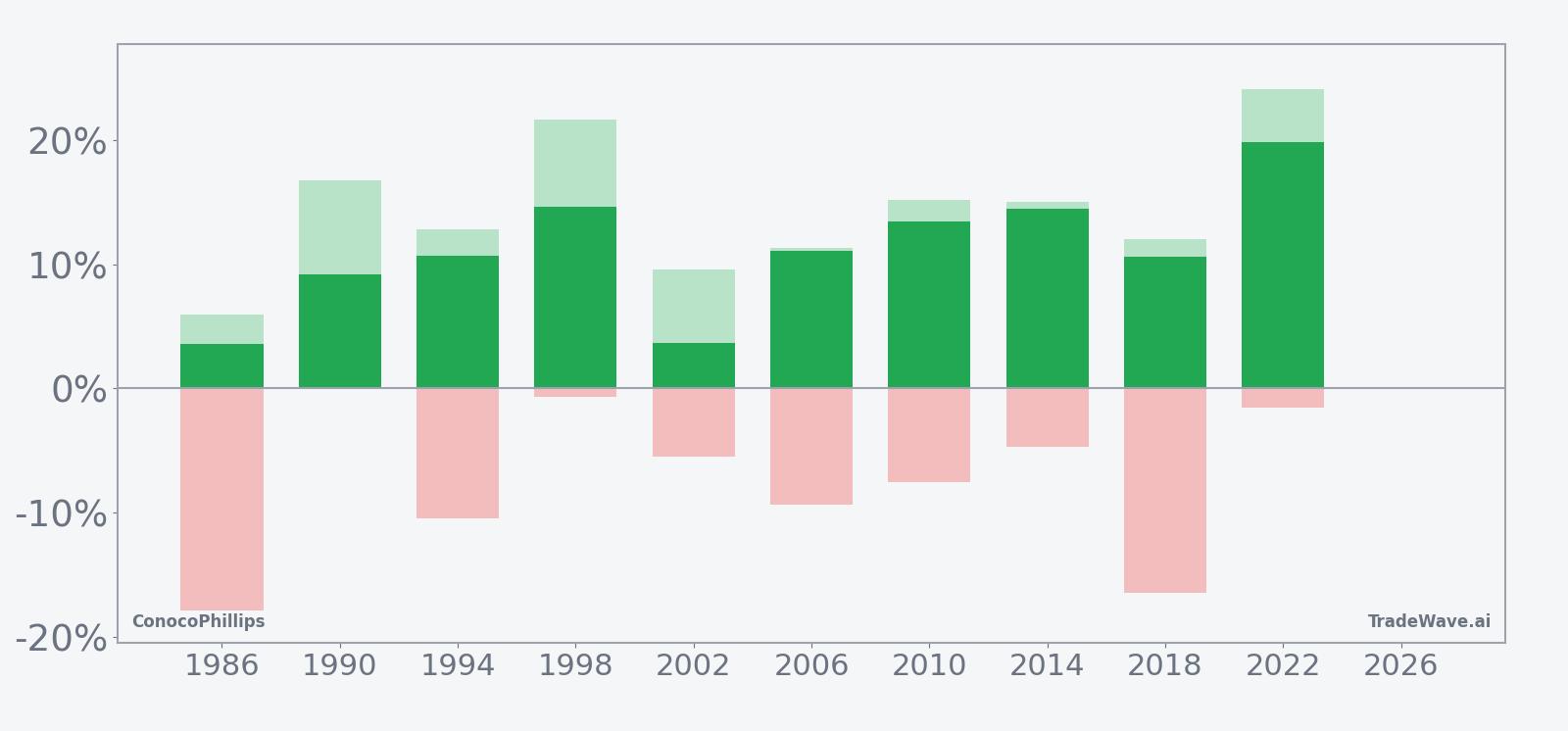
Looking at individual years highlights both the consistency of the gains and the variability of the path. In 2022, for example, ConocoPhillips entered the window around $75.63 and exited near $90.61, for a 19.8% net return, with a maximum favorable move of 24.12% and only a shallow 1.54% worst drawdown from entry. By contrast, 1986 delivered a smaller 3.57% gain, with a 5.96% best run-up but a much deeper 17.85% adverse move at one point, illustrating that even winning years can involve sizable pullbacks before the pattern plays out.
The maximum favorable move, or best intraperiod excursion from the entry price, has typically been in the low to mid-teens in percentage terms, with several years such as 1998 and 2022 seeing more than 20% peak gains during the window. The maximum adverse move, or worst drawdown from entry, has ranged from mild single-digit dips to double-digit setbacks like the 16.46% pullback in 2018 and the 17.85% slide in 1986 before the stock recovered. That combination points to a window where upside has historically dominated by the finish, but where volatility and interim stress have been part of the journey.
The historical seasonal trend chart for this pattern shows a generally upward-sloping average path, with gains tending to build steadily rather than arriving in a single burst. In many of the past midterm years, the first few weeks of the window saw choppy trading or modest weakness, followed by a more persistent climb into the latter half of the period, which is consistent with the mix of early drawdowns and strong final outcomes in the per-year data.
The cumulative return profile across the last 10 midterm election years reinforces that impression of steady accrual. When the returns from each year are stacked together, the line rises in a relatively smooth fashion over the 83 days, suggesting that while individual years can deviate, the aggregate behavior has been to add value gradually through the window rather than to depend on a handful of outsized spikes.
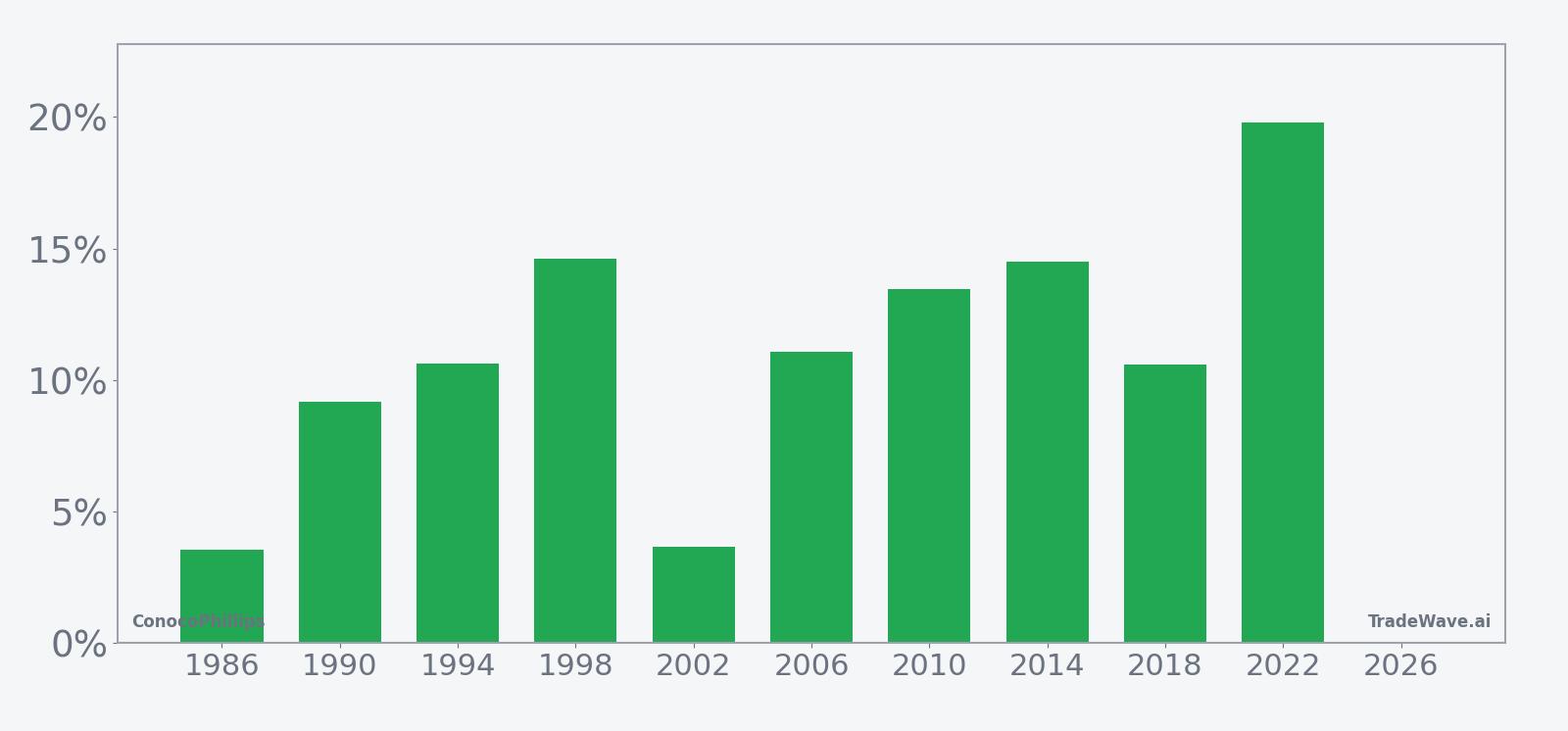
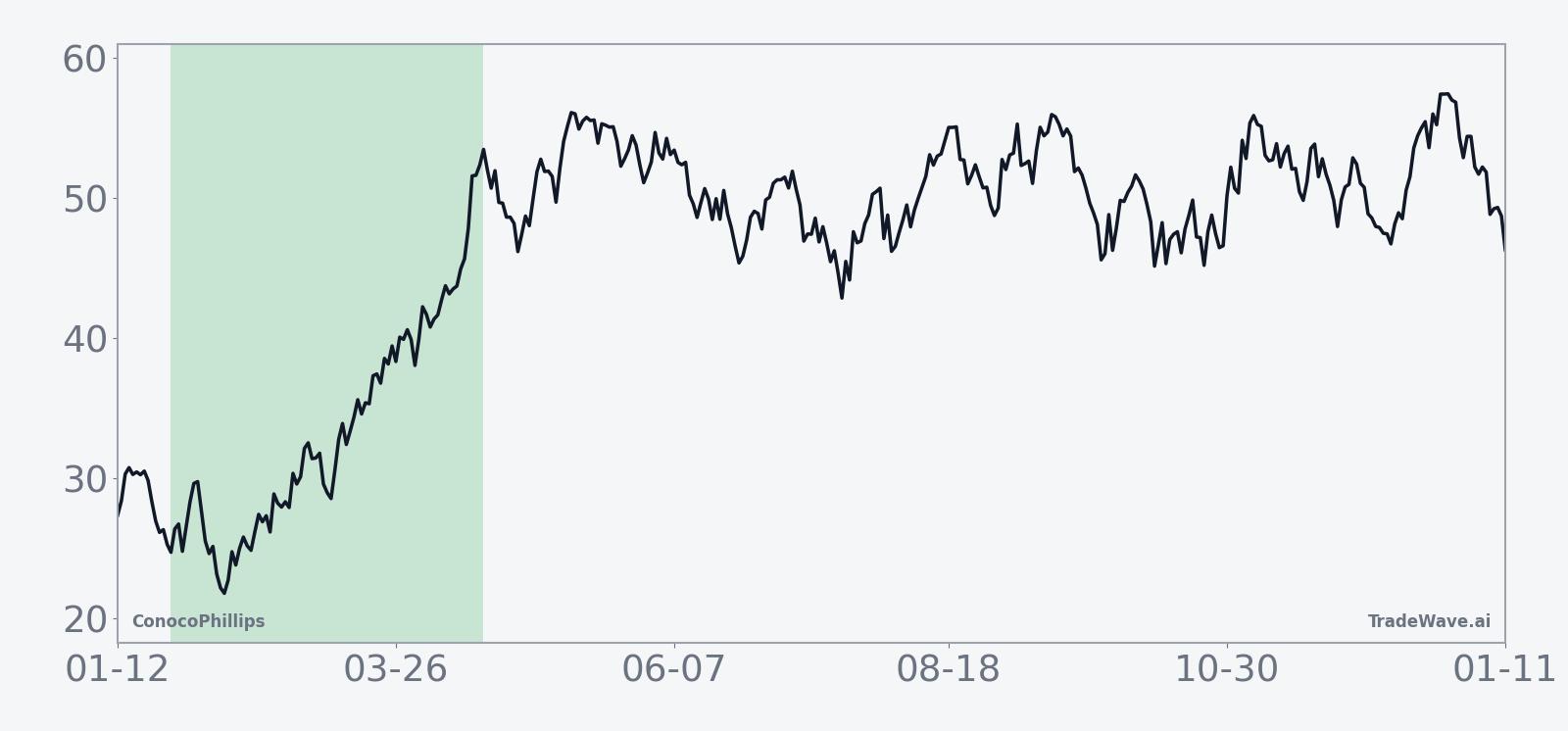
Year-by-year net returns alongside peak favorable and adverse moves illustrate how upside and drawdowns have interacted within this window.
History does not guarantee future results, and adverse excursions can be large even in winning windows.
Taken together, the historical pattern defines the quantitative seasonal backdrop for the current period.
Price and near-term drivers
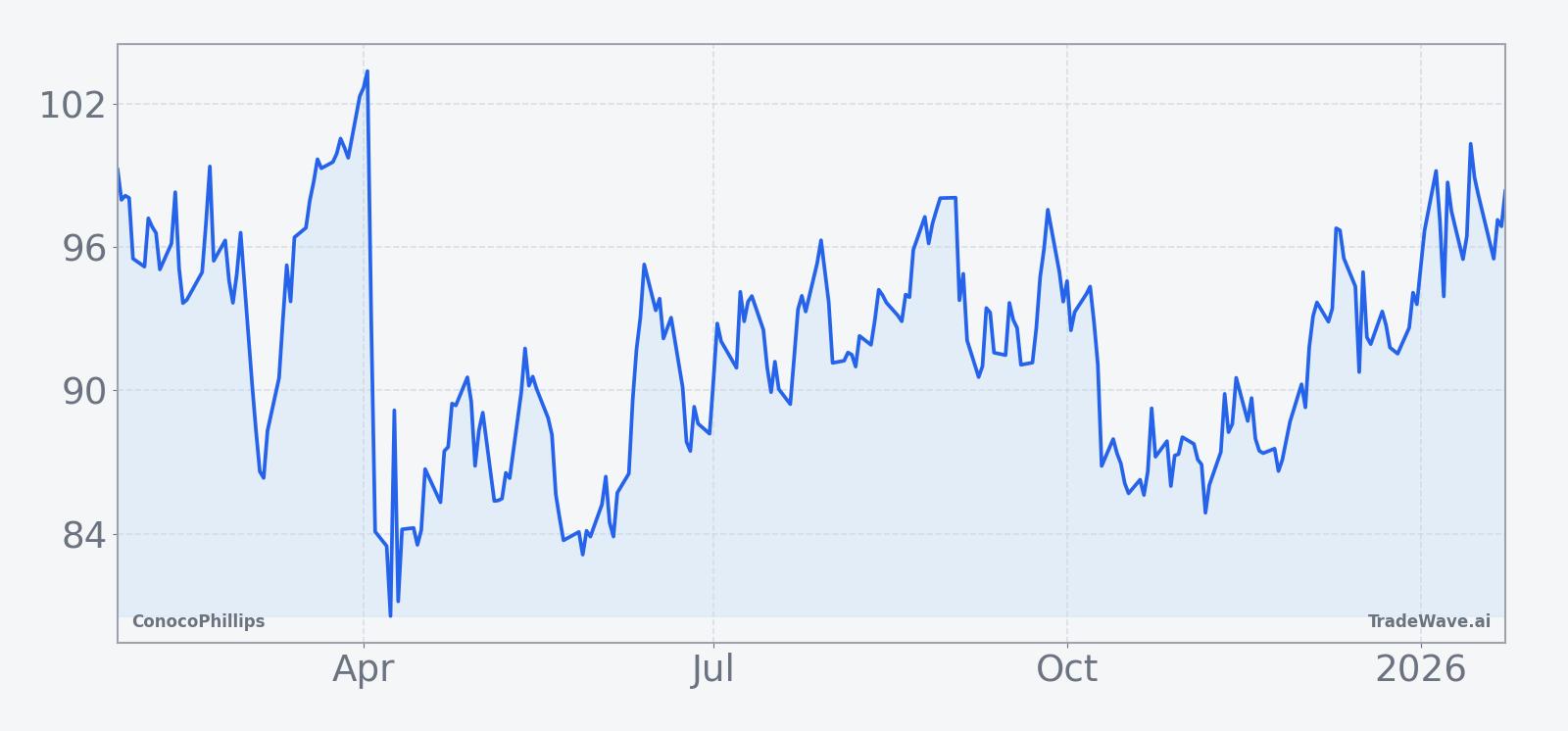
ConocoPhillips shares last changed hands at $90.29, leaving the stock trading in the middle of its recent range as investors weigh company-specific progress against a softer oil tape. The lack of fresh extremes in either direction means the new seasonal window is opening against a backdrop of consolidation rather than a stretched rally or deep sell-off.
On Nov 30, 2025, ConocoPhillips raised its quarterly dividend by 8% to $0.84 per share, a move that underscored management’s confidence in cash generation and positioned the stock more firmly in the camp of income-oriented energy names.[1] That followed a Nov 6, 2025 earnings report in which the company posted adjusted profit of $1.61 per share for the third quarter, beating estimates of $1.43 as higher production and lower costs offset pressure from weaker crude prices.[4] In that same update, ConocoPhillips lifted its full-year 2025 production forecast to 2.375 million barrels of oil equivalent per day from a prior range of 2.35 million to 2.37 million, signaling a willingness to lean on volume growth even as it tightens spending.[4]
Those corporate moves have unfolded against a more challenging macro backdrop for oil producers. In 2025, Brent crude prices were about 13% lower than a year earlier, squeezing revenue for upstream companies like ConocoPhillips even as they worked to offset the hit through efficiency gains and portfolio optimization.[4] At the same time, higher inflation and U.S. import tariffs have added to cost pressures, raising the stakes for capital discipline and operational execution across the sector.[5] Analysts have generally remained constructive on the stock, with an “Outperform” consensus rating and a consensus price target of $123.82 from providers including TipRanks and GuruFocus, reflecting expectations that ConocoPhillips can navigate the cycle with a combination of balance-sheet strength and disciplined growth.[1][2]
Strategically, the company has also been reshaping its cost base and workforce. In Sep 2025, ConocoPhillips announced plans for deep layoffs of up to 25% of staff as part of a broader push to cut controllable costs and sharpen its competitive position in a lower-price environment.[5] Earlier in 2025, it outlined workforce reductions tied to post-merger integration, reinforcing the message that management is prepared to take difficult steps to protect returns and fund shareholder distributions even when headline oil prices are not providing a tailwind.[2]
The chart below situates the latest move in its recent multi-month context.
Election-cycle and macro backdrop
The current pattern phase corresponds to the midterm election year in the U.S. presidential cycle, while the calendar itself is also in the early part of that midterm year. Historically, midterm years have featured a two-part structure for risk assets, with choppier conditions and policy uncertainty early in the year followed by a more constructive tone as the political outlook clarifies and markets begin to look ahead to the pre-election year.
For energy producers such as ConocoPhillips, this phase often coincides with debates over regulation, drilling permits, export policy and climate-related rules that can influence long-term investment decisions. Fiscal policy and spending priorities can also affect demand expectations for oil and gas, particularly through infrastructure programs and industrial activity. Against that backdrop, the fact that ConocoPhillips’ seasonal window is defined specifically by the last 10 midterm election years means it is capturing how the stock has historically traded through a recurring mix of policy noise, rate uncertainty and shifting growth expectations rather than through a generic calendar slice.
Sector-wide, the oil industry has been contending with OPEC+ production decisions and broader economic uncertainty, which have contributed to the recent decline in Brent prices and reinforced the need for capital discipline.[5] ConocoPhillips’ response has been to emphasize cost control, portfolio high-grading and shareholder returns, including the dividend increase and a focus on efficient production growth.[1][4][5] That combination of a disciplined corporate stance and a historically supportive seasonal window may be particularly relevant as investors navigate a midterm-year environment where macro headlines can shift quickly.
What to watch in this window
As ConocoPhillips moves through this 83-day midterm-year window, investors will be watching how closely the stock’s behavior tracks the historical pattern of steady, if sometimes volatile, gains. One focal point will be the company’s next set of operational updates, including any revisions to production guidance or capital spending plans that could either reinforce or challenge the narrative of disciplined growth that underpinned the late-2025 earnings beat and dividend hike.[1][4]
Macro and policy developments will also matter. Any shifts in OPEC+ output strategy, signs of stabilization or renewed weakness in Brent prices, and changes in U.S. regulatory or fiscal policy toward the energy sector could all influence how the stock trades within the window.[4][5] Traders may pay particular attention to whether pullbacks during this period resemble the double-digit intraperiod drawdowns seen in some past midterm years or whether downside remains more contained, which would mark a departure from the historical MAE profile even if the end result is still positive.
From a levels perspective, the key question is whether ConocoPhillips can build on its current consolidation zone and sustain an upward trajectory consistent with the average 11.11% gain seen in prior midterm-year windows, or whether macro headwinds and policy uncertainty cap rallies more quickly. Follow-through on the company’s cost-cutting and capital-discipline agenda, including the execution of workforce reductions and integration plans, will be another marker of how well management is positioned to navigate any volatility that arises.[2][5]
Ultimately, the historical pattern does not dictate outcomes, but it does frame expectations. If ConocoPhillips can pair its focus on efficiency and shareholder returns with a macro backdrop that is at least stable, the seasonal tendency for gains in this part of the midterm election year will serve as a constructive backdrop. If, instead, oil prices weaken further or policy risks escalate, the same history of sizable intraperiod swings is a reminder that even in windows that have always finished higher, the path can be bumpy along the way.
Sources
- [1] CNBC, “Top Wall Street analysts recommend these dividend stocks for stable income,” Nov 30, 2025.
- [2] GuruFocus, “ConocoPhillips (COP) Plans Workforce Reductions Post-Merger,” Apr 23, 2025.
- [3] Yahoo Finance, “ConocoPhillips (COP): Among the Best Stocks to Buy Before Spring,” Mar 4, 2025.
- [4] Reuters, “ConocoPhillips lifts dividend, raises output forecast after profit beat,” Nov 6, 2025.
- [5] Reuters, “ConocoPhillips' deep layoffs highlight need for capital discipline, analysts say,” Sep 8, 2025.