Data-Center Buildout and Gas Expansion Plans Stir Debate on NextEra Energy (NEE) Strategy
NextEra Energy is stepping into a short, historically soft 13-day pattern just as investors weigh data-center expansion plans, nuclear restarts and surging power demand in one of 2025’s strongest sectors.
Key takeaways
- NextEra Energy is entering a 13-day seasonal window that, in years after U.S. presidential elections, has historically favored short positions rather than long exposure.
- The pattern runs from Dec 31 and is grouped by the year after the presidential election, a phase that often reflects policy digestion and choppy trading rather than clean trends.
- Across the sample, the window has been profitable for the trade direction in 92% of years, with 11 winners and 1 loser, despite its short length.
- Average profit in winning years is 4.08%, while Avg Profit - All, which includes the lone losing year, is 4%, pointing to relatively consistent outcomes.
- The TradeWave Ratio of 1.66 and a Sharpe ratio of 1.08 suggest that price has typically moved meaningfully in the trade direction with risk-adjusted returns that are solid for such a brief window.
- Historical best and worst intraperiod moves show that adverse swings can still be sizable, underscoring the need to respect downside risk even in a statistically favorable setup.
According to historical data from TradeWave.ai, this brief post-election window for NextEra Energy has displayed a distinct pattern across prior cycles. The next section looks at how that behavior has lined up with the broader presidential election calendar and what it implies for the current stretch.
Seasonal window
This seasonal window is currently underway, spanning 13 days from Dec 31, and has historically been a weak stretch for NextEra Energy in the year after the presidential election. With the stock’s latest price not disclosed, investors are watching this short regime against a backdrop of strong sector performance and elevated expectations rather than a clear reference to 52-week extremes.
Grouping the data by the presidential election cycle matters here because the year after the presidential election often brings a shift from campaign promises to concrete policy, which can alter the regulatory and rate backdrop for utilities more abruptly than in other phases. For a company like NextEra, whose fortunes are tied to long-duration projects, renewable incentives and grid investment, that policy digestion period can translate into short bursts of volatility that repeat from cycle to cycle rather than from one calendar year to the next.
This seasonal window begins on 2025-12-31 and spans 13 days. Historically, during this period, NextEra Energy has shown a weak directional tendency aligned with a short trade direction, meaning that years in which the stock drifted lower have been the favorable outcomes for this pattern.
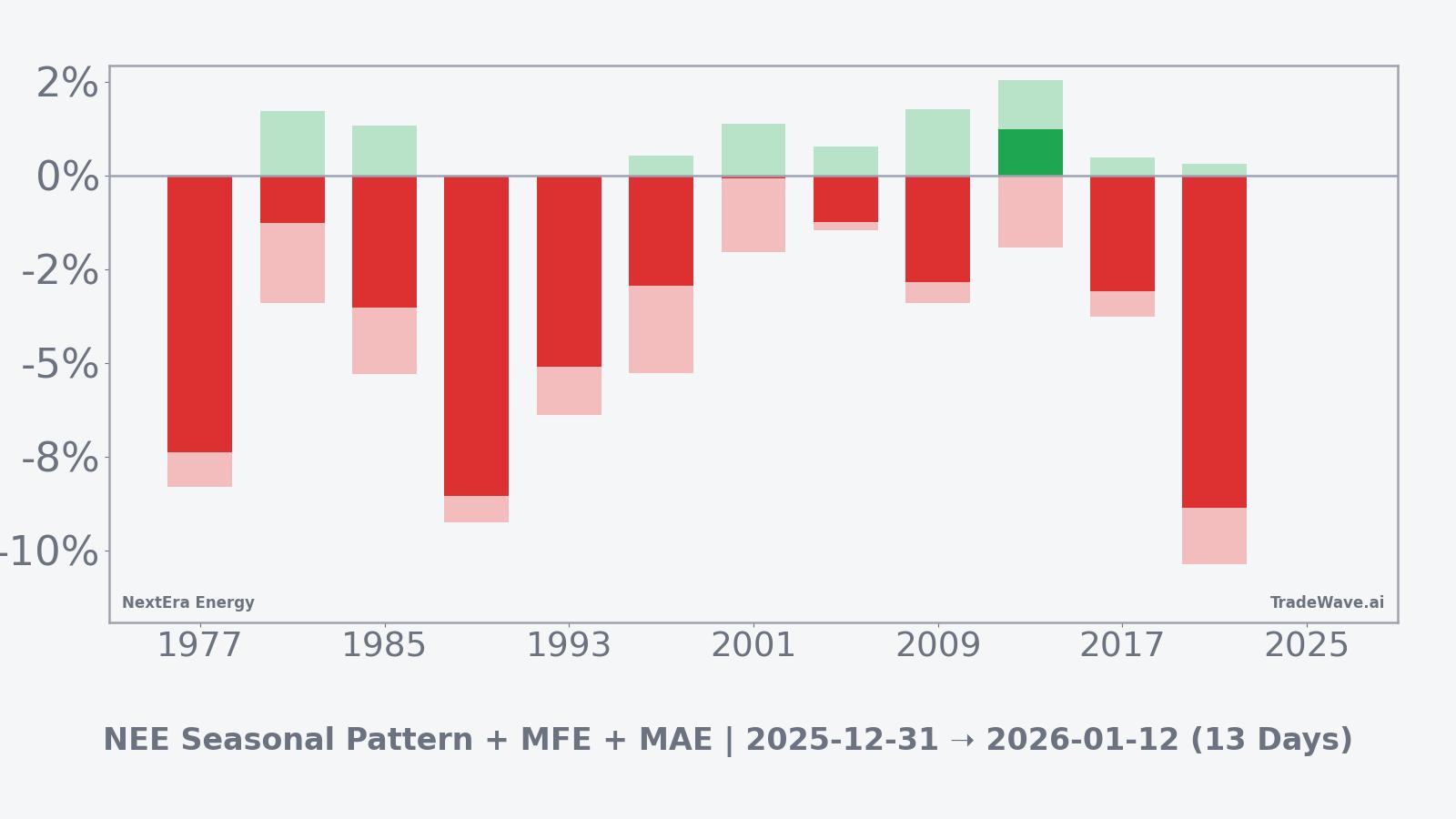
The trade direction for this setup is short, and the statistics show that the pattern has been profitable in 92% of years, with 11 winners and 1 loser. In other words, in most prior years that match this election-cycle phase, a short bias during this 13-day stretch has aligned with the prevailing move rather than fighting it.
Average profit in winning years is 4.08%, while Avg Profit - All, which includes every year in the sample, is 4%. That small gap between winners-only and all-years averages suggests that the lone losing year did not dramatically offset the gains from the many favorable years, and that outcomes have clustered reasonably tightly around the typical result.
Avg Profit reflects winners only, while Avg Profit - All includes every year in the sample. The TradeWave Ratio (TWR) of 1.66 reflects how far price typically travels in the trade direction within the window regardless of the final close, which in this case points to meaningful follow-through in years when the short bias has worked.
The Sharpe ratio for this pattern is 1.08, indicating that, based on end-of-window outcomes, the risk-adjusted average return has been solid for such a brief holding period. That does not remove risk, but it does highlight that the historical reward has generally been commensurate with the volatility experienced during the window.
Looking at individual years, the weakest outcome for the short pattern came in 2013, when the stock finished the window up 1.24%, making that a losing year for the short setup despite a maximum favorable move of 2.55% at one point during the stretch. On the other side, 2021 stands out as a strong year for the pattern, with a net return of -8.86% in the stock and a maximum adverse move of -10.37% from the entry level, which represented a deep but ultimately favorable slide for a short position.
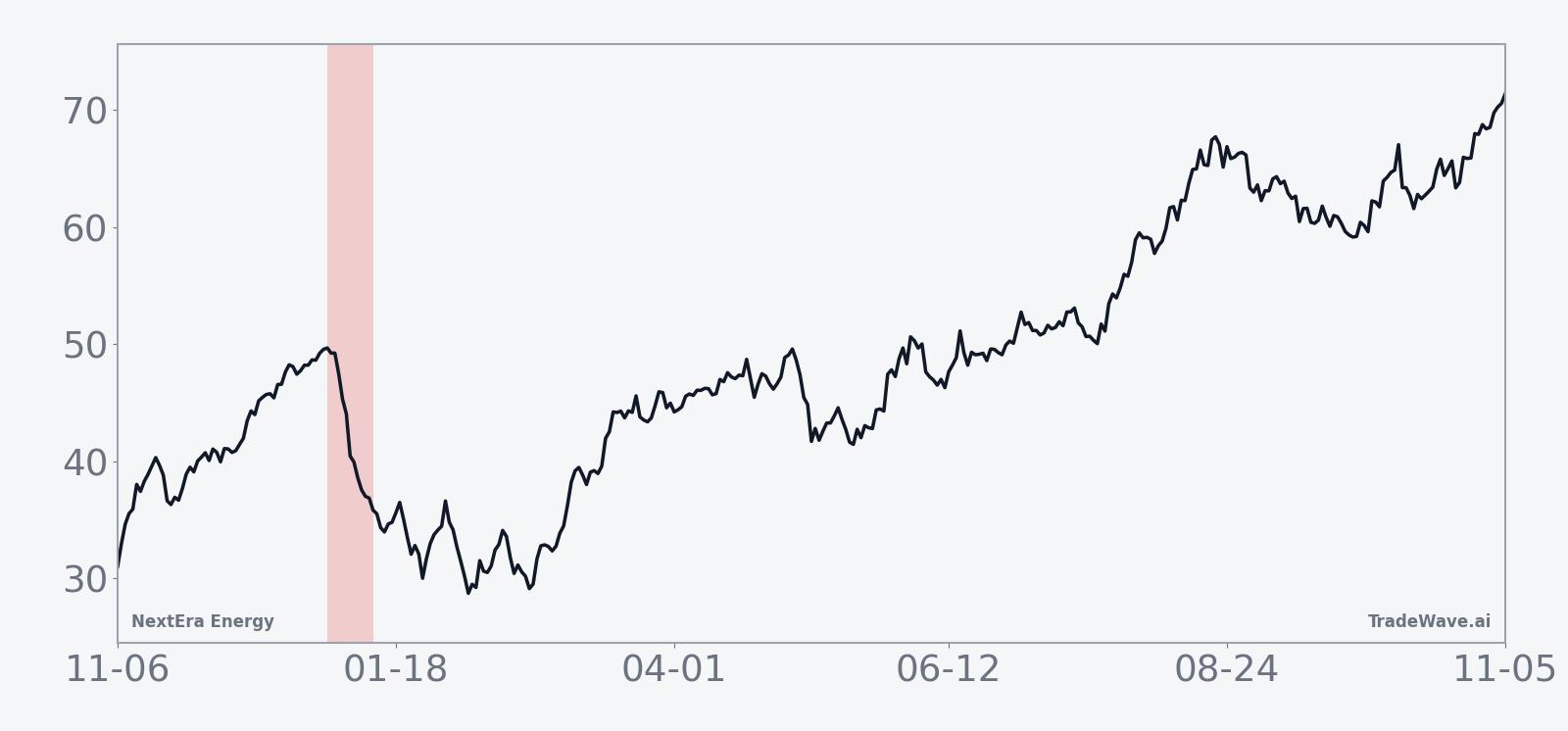
The historical seasonal trend chart for this window shows that, on average, the pattern tends to lean in the trade direction rather than chopping aimlessly, with weakness often building as the window progresses rather than arriving in a single sharp break. That profile suggests that, in prior cycles, pressure on the stock has tended to accumulate over the full 13-day span in the year after the presidential election.
Year-by-year bars that combine net results with best and worst intraperiod moves help clarify how often weakness has persisted and how large swings have been inside the window.
History does not guarantee future results, and maximum adverse excursions can be large even in windows that have been profitable in most prior years.
Taken together, the historical pattern defines the quantitative seasonal backdrop for the current period as NextEra wraps up the year after the presidential election and heads toward the midterm election year, when a different set of policy and rate dynamics will come into focus.
Price and near-term drivers
NextEra Energy’s latest price action comes against a backdrop of strong sector momentum, with utilities ranking as the third-best performing S&P 500 sector in 2025 and the stock itself highlighted as a potential technical breakout candidate tied to AI-related demand and data centers.[8] That strength has unfolded even as investors digested a series of company-specific headlines, including new growth initiatives and regulatory milestones that could reshape the company’s generation mix and earnings profile.
On Dec 8, NextEra announced plans with Google to develop data centers paired with power plants and to expand its natural gas operations, a move that initially saw shares dip 2.6% as investors weighed capital needs and fuel-mix implications against the long-term opportunity in AI-driven load growth.[3] The strategy underscores how deeply the company is tying its future to digital infrastructure, positioning itself as both a power supplier and a partner in the build-out of energy-hungry computing facilities.
Earlier in the year, the company secured approval from the Federal Energy Regulatory Commission to restart the Duane Arnold nuclear plant in Iowa, a decision that could boost capacity and revenue while adding another low-carbon asset to its portfolio.[1] Nuclear restarts can be capital-intensive and politically sensitive, but they also offer baseload power that complements intermittent renewables, which is increasingly valuable as grids absorb more solar and wind.
Management has framed these moves against a bullish long-term demand backdrop, with CEO John Ketchum projecting a 55% jump in global power demand over the next 20 years, a trajectory that would support continued investment in renewables, transmission and firming capacity.[4] That view aligns with broader estimates that U.S. electricity demand growth through 2027 will be akin to adding another California to the grid, driven in part by data centers, electrification and industrial reshoring.[6]
Those macro forces have helped turn utilities from a traditionally defensive corner of the market into a more growth-oriented story in 2025, with investors increasingly focused on which names can capture AI-related load while managing rate and regulatory risk.[5][8] For NextEra, the combination of nuclear restarts, gas expansion and data-center partnerships places it squarely at the center of that debate as the market transitions from the year after the presidential election into the midterm election year, when policy and rate decisions can become more contentious.
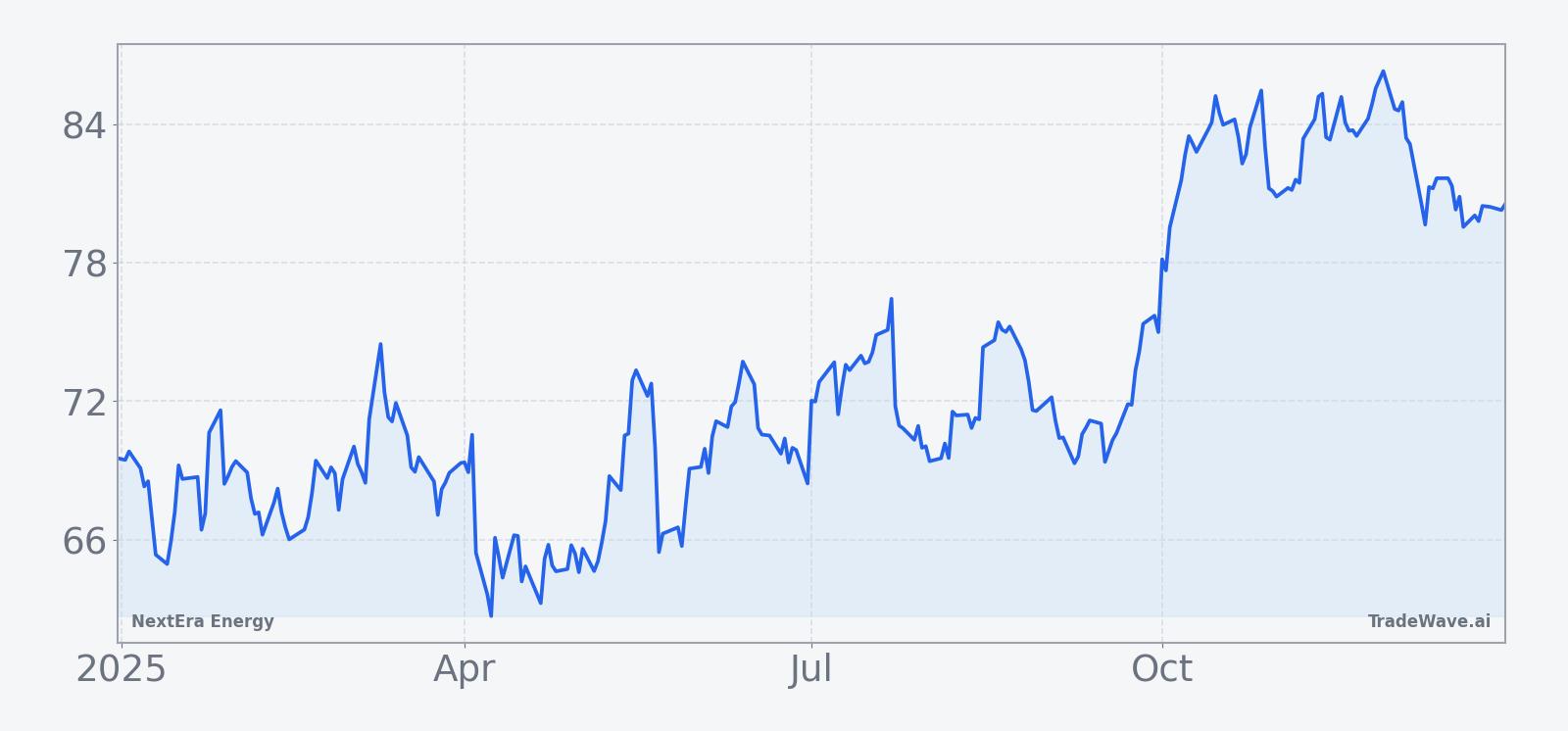
The chart below situates the latest move in its recent multi-month context.
Macro and policy backdrop
The broader macro environment remains central to how this seasonal window might play out. Rising electricity demand, driven by AI, electrification and industrial projects, is colliding with an evolving regulatory framework that must balance decarbonization goals with reliability and affordability.[4][6] For utilities, that mix can translate into periods of rapid repricing when rate decisions, incentive structures or permitting rules shift, particularly in the years immediately following a presidential election.
In 2025, that tension has been visible in the way investors have rewarded utilities with clear growth pathways tied to data centers and grid upgrades while remaining sensitive to capital intensity and balance-sheet risk.[5][8] NextEra’s decision to lean into nuclear restarts and gas alongside renewables reflects a pragmatic approach to meeting surging load, but it also exposes the company to regulatory scrutiny and potential changes in how different generation types are treated under future policy regimes.[1][3]
As the calendar turns toward the midterm election year, markets will increasingly focus on how Congress and regulators approach issues such as transmission permitting, capacity markets and incentives for firm low-carbon power. Historically, midterm years can bring their own volatility as policy debates intensify, which is one reason election-cycle groupings can matter for short seasonal windows like the one now in play for NextEra.
What to watch in this window
For the current 13-day stretch, traders and investors will be watching how NextEra trades relative to its strong 2025 backdrop and the historically weak bias of this specific post-election window. One focal point will be whether the stock shows signs of fatigue after a year in which utilities have already outperformed, or whether momentum tied to AI-driven demand and data-center partnerships continues to dominate.[5][8]
Policy and regulatory headlines will also matter, particularly any updates related to the Duane Arnold nuclear restart, gas expansion plans or broader grid investment frameworks that could alter the company’s earnings trajectory.[1][3] Sharp moves around such news would be consistent with the historical pattern’s tendency for meaningful intraperiod swings, even when the final outcome has often favored the short direction.
From a macro perspective, incoming data on electricity demand, industrial activity and AI-related infrastructure spending will help investors gauge whether the long-term growth narrative that management has outlined is tracking expectations.[4][6] If those indicators remain firm, any weakness during this seasonal window could be viewed more as a digestion phase within a larger structural story rather than a fundamental break.
Finally, behavior inside the window itself will offer clues about how closely the market is tracking the historical pattern. A gradual softening in the stock over the full 13 days would align with the typical seasonal profile, while a sharp rally or unusually muted trading would mark a departure from prior years. Either way, the combination of a statistically weak post-election window, a strong sector backdrop and an approaching midterm year makes this a period where short-term price action and policy headlines may carry more information than usual for NextEra Energy.
Sources
- [1] Seeking Alpha, "NextEra Energy wins FERC approval for nuclear restart of Iowa's Duane Arnold plant" (Aug 27, 2025).
- [2] Reuters, "NextEra workers net $45 million from sales of company stock" (Jun 12, 2025).
- [3] Bloomberg, "Google and NextEra to Develop Data Centers With Power Plants" (Dec 8, 2025).
- [4] Reuters, "CERAWEEK NextEra Energy expects 55% jump in global power demand over the next 20 years, CEO says" (Mar 10, 2025).
- [5] CNBC, "Once boring utility stocks are now an investor favorite. These names have the most upside from here" (Nov 10, 2025).
- [6] Seeking Alpha, "U.S. electricity demand growth through 2027 will be like adding another California" (Feb 14, 2025).
- [8] CNBC, "Utility stocks are benefiting from the AI boom. This one could be the next to break out" (Oct 6, 2025).