Cintas (CTAS) UniFirst Takeover Push Raises Questions on Integration Risk and Break Fee Protections
Cintas is climbing as it moves through a year-after-the-election seasonal stretch that has historically delivered steady gains, giving investors a structured backdrop for the stock’s next phase after its latest deal news.

Key takeaways
- Cintas is in a long, 341-day seasonal window tied to the year after the presidential election, which began on Dec 27, 2025.
- The pattern has a long trade direction and has been profitable in 100% of the 10 historical years in this election-cycle phase, with 10 winners and 0 losers.
- Average profit across those winning years is 13.25%, with a cumulative return of 233% and an annualized return of 12.81% over the sample.
- The TradeWave Ratio of 1.26 suggests price has typically traveled meaningfully in the long direction within the window, while a Sharpe ratio of 0.88 points to solid risk-adjusted outcomes.
- Intraperiod swings have included sizable maximum favorable moves alongside notable adverse excursions in some years, underscoring that gains have not come in a straight line.
- The window sits in the late part of the year-after-the-election phase, just before markets transition toward the midterm-election year, when policy and growth narratives often shift.
According to historical data from TradeWave.ai, this stretch for Cintas has shown a distinct seasonal character across prior election cycles. The following section unpacks how that backdrop has behaved in the past and what it may signal about the current environment.
Seasonal window
This seasonal window is currently underway, spanning 341 trading days, and has historically been a strong stretch for Cintas in the year after the presidential election. Today the stock last traded at $192, up 2.36% on the session, leaving investors to weigh that strength against a backdrop of limited disclosed context on its 52-week range or year-to-date performance.
Grouping the data by the presidential election cycle matters here because company spending on uniforms, facilities and safety services often tracks broader policy and fiscal trends, which tend to follow a four-year rhythm. The year after the presidential election is typically a digestion phase as new policies are implemented and corporate budgets adjust, so seeing a consistent pattern for Cintas in this part of the cycle can help investors frame how demand from its business customers has historically evolved as Washington’s agenda moves from campaigning to governing.
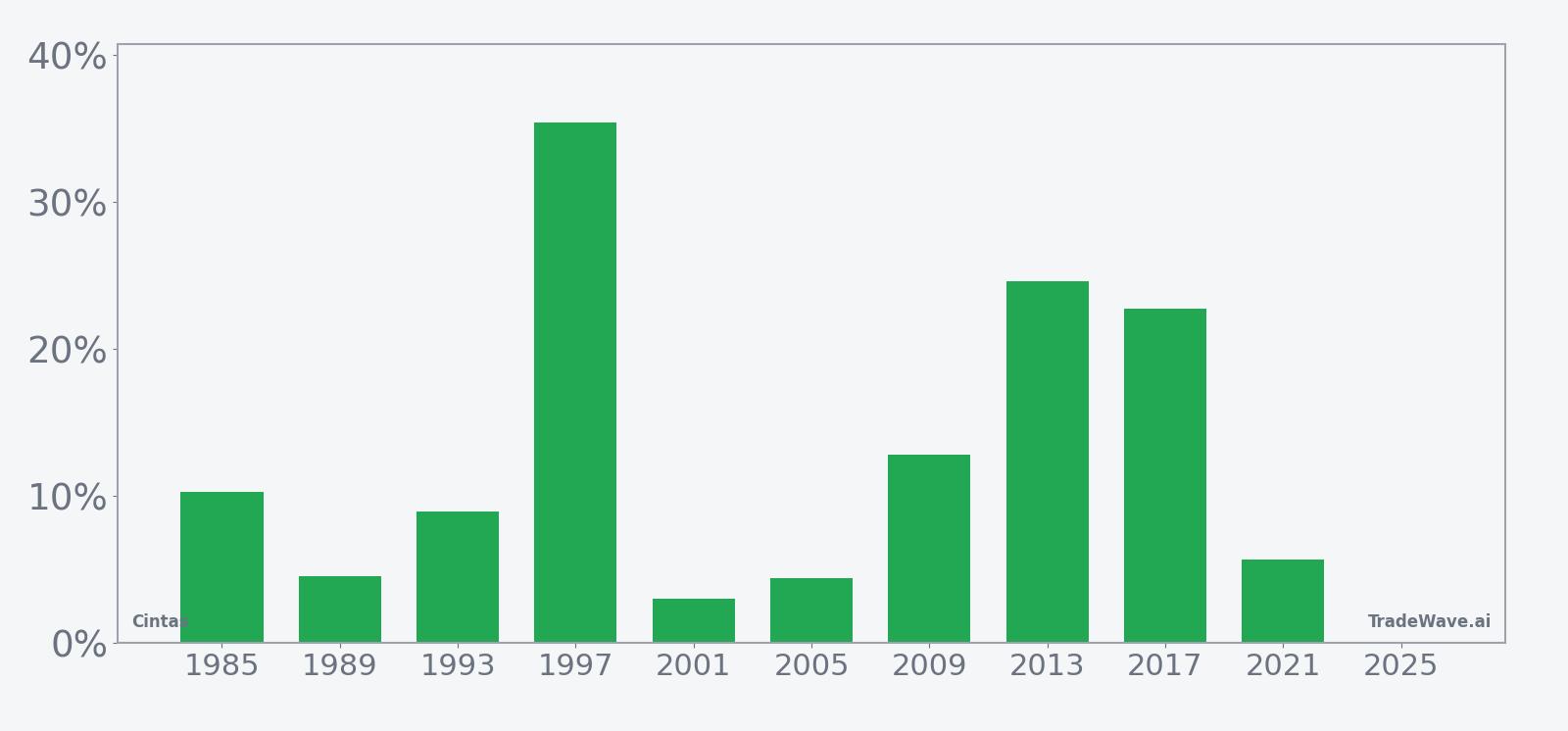
Across the 10 historical years in this election-cycle grouping, the pattern has been consistently positive for a long bias. Percent Profitable stands at 100%, with 10 winners and 0 losers, and average profit of 13.25% indicates that, in winning years, Cintas has tended to post double-digit gains over the full 341-day span. The cumulative return across those years is 233%, translating to an annualized return of 12.81%, which is notable for a single, repeated seasonal regime rather than a continuous buy-and-hold.
The distribution of outcomes shows that while every year in the sample finished higher, the magnitude of gains has varied. The strongest year in the dataset was 1997, when the stock logged a net return of 35.42% within the window, while the softest outcome was 2001, with a still-positive 3.06% gain. Median profit of 9.6% sits below the average, suggesting that a handful of outsized years, such as 1997 and 2013 with a 24.61% gain, pulled the mean higher.
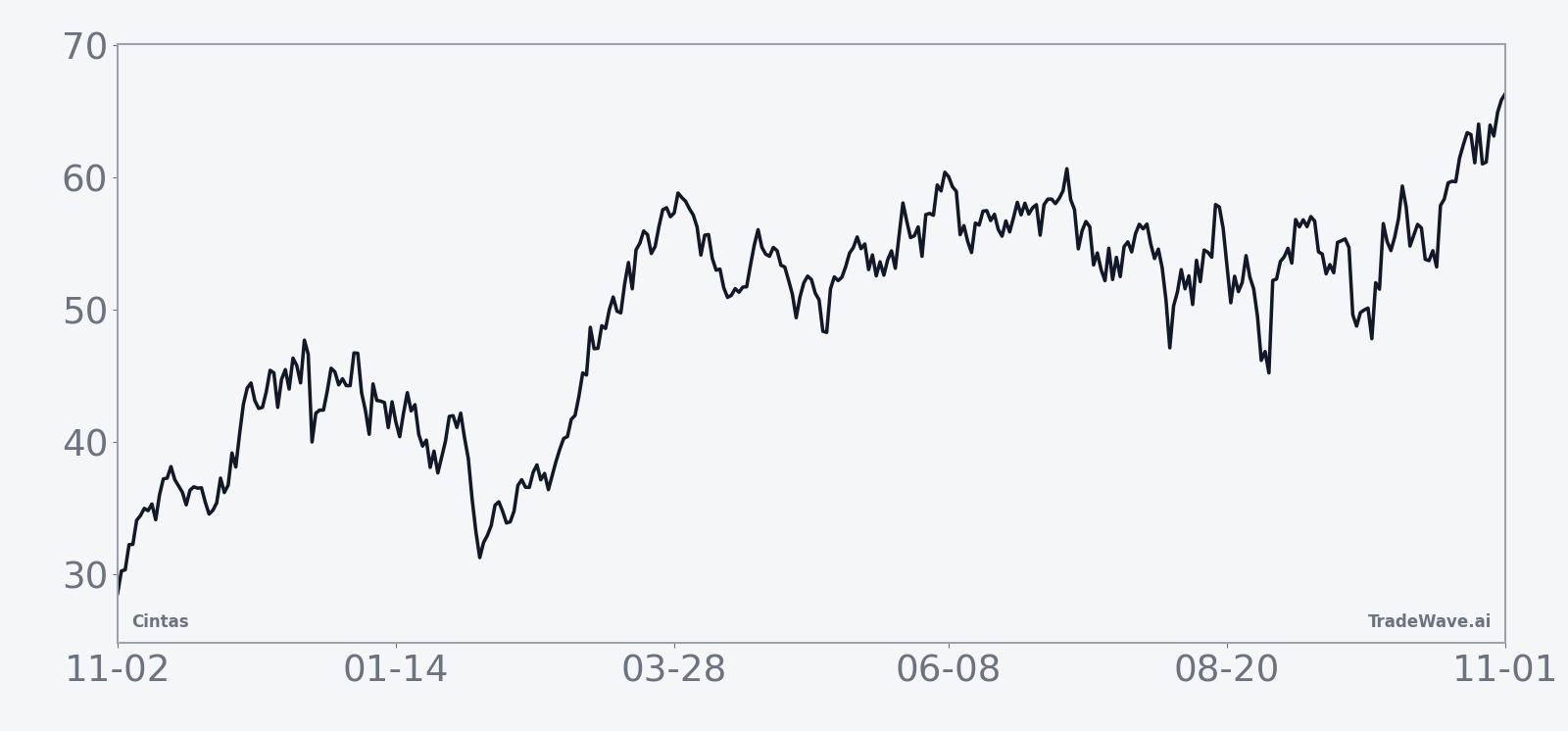
The historical seasonal trend chart suggests that returns have tended to build over the course of the window rather than arriving in a single burst. In several years, gains accelerated in the middle and later portions of the period, which aligns with the idea that corporate uniform and facility spending can pick up as the post-election policy environment becomes clearer and businesses finalize budgets for the following fiscal year.
Year-by-year bars that combine net results with peak run-ups and worst drawdowns help clarify how much the stock has typically moved inside the window.
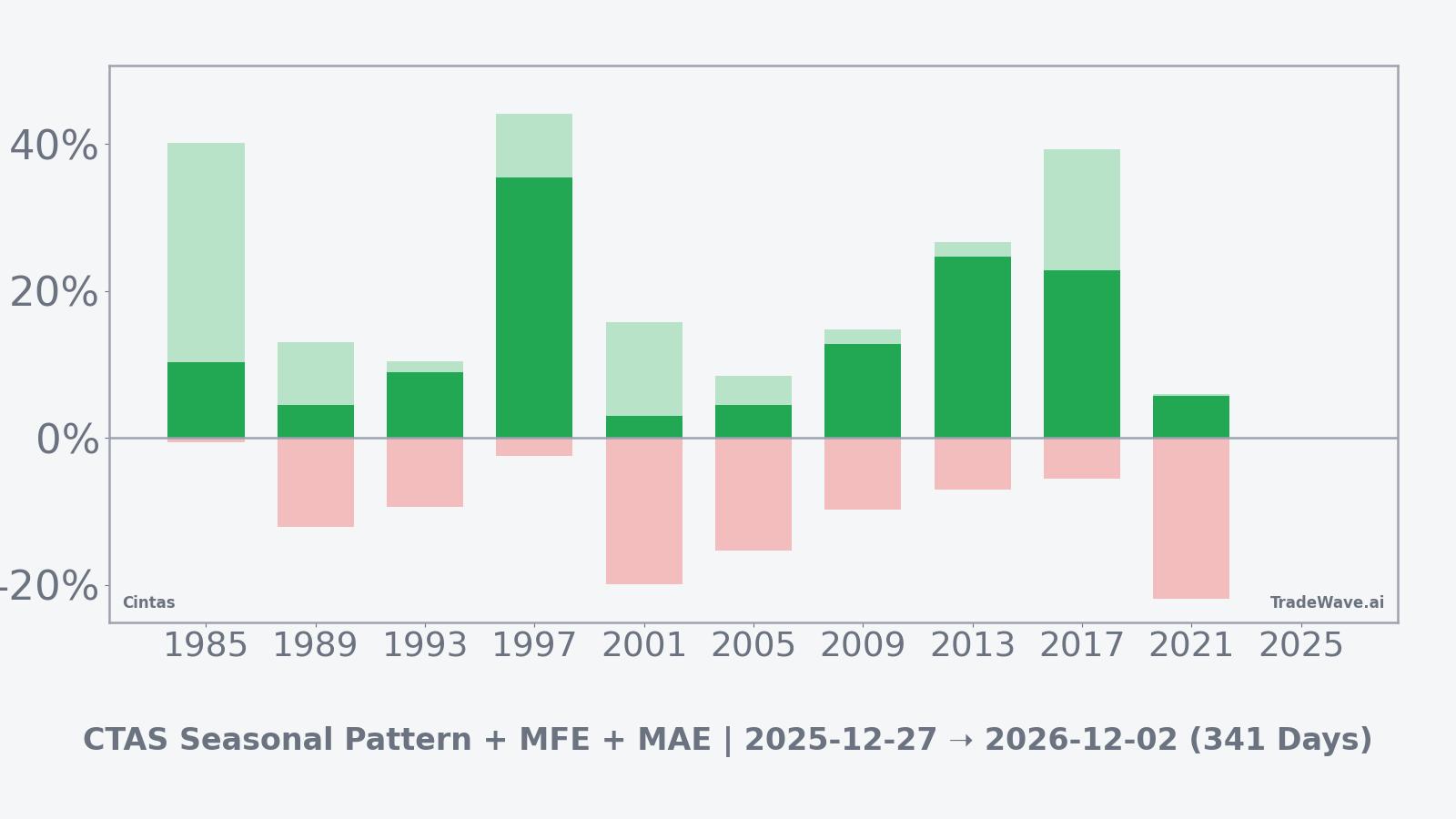
The combined net, maximum favorable move and maximum adverse move profile shows that upside potential has often come with meaningful swings along the way. In 1997, for example, the best intraperiod move reached 44.05% while the worst drawdown was limited to 2.5%, whereas in 2021 the stock ultimately gained 5.72% but experienced a maximum adverse move of 21.82% before finishing higher. Other years, such as 1989 and 2001, also saw double-digit adverse excursions of 12.04% and 19.93% respectively, even though they ended with modest gains, underscoring that this has been a constructive but sometimes volatile stretch.
The TradeWave Ratio of 1.26 indicates that, on average, Cintas has typically traveled a meaningful distance in the long direction within the window, independent of where it ultimately closed. Combined with a Sharpe ratio of 0.88, which measures risk-adjusted average return based on end-of-window outcomes, the data points to a historically favorable balance between reward and volatility for this long seasonal setup in the year after the presidential election.
As markets move from the late part of the year-after-the-election phase toward the midterm-election year, this pattern also highlights how Cintas has historically navigated that transition. The company’s customers span industries that can be sensitive to regulation, labor rules and infrastructure spending, so the way the stock has tended to behave across this policy handoff offers one lens on how investors have previously priced in shifting macro and legislative backdrops.
History does not guarantee future results; adverse excursions (MAE) can be large even in winning windows.
Price and near-term drivers
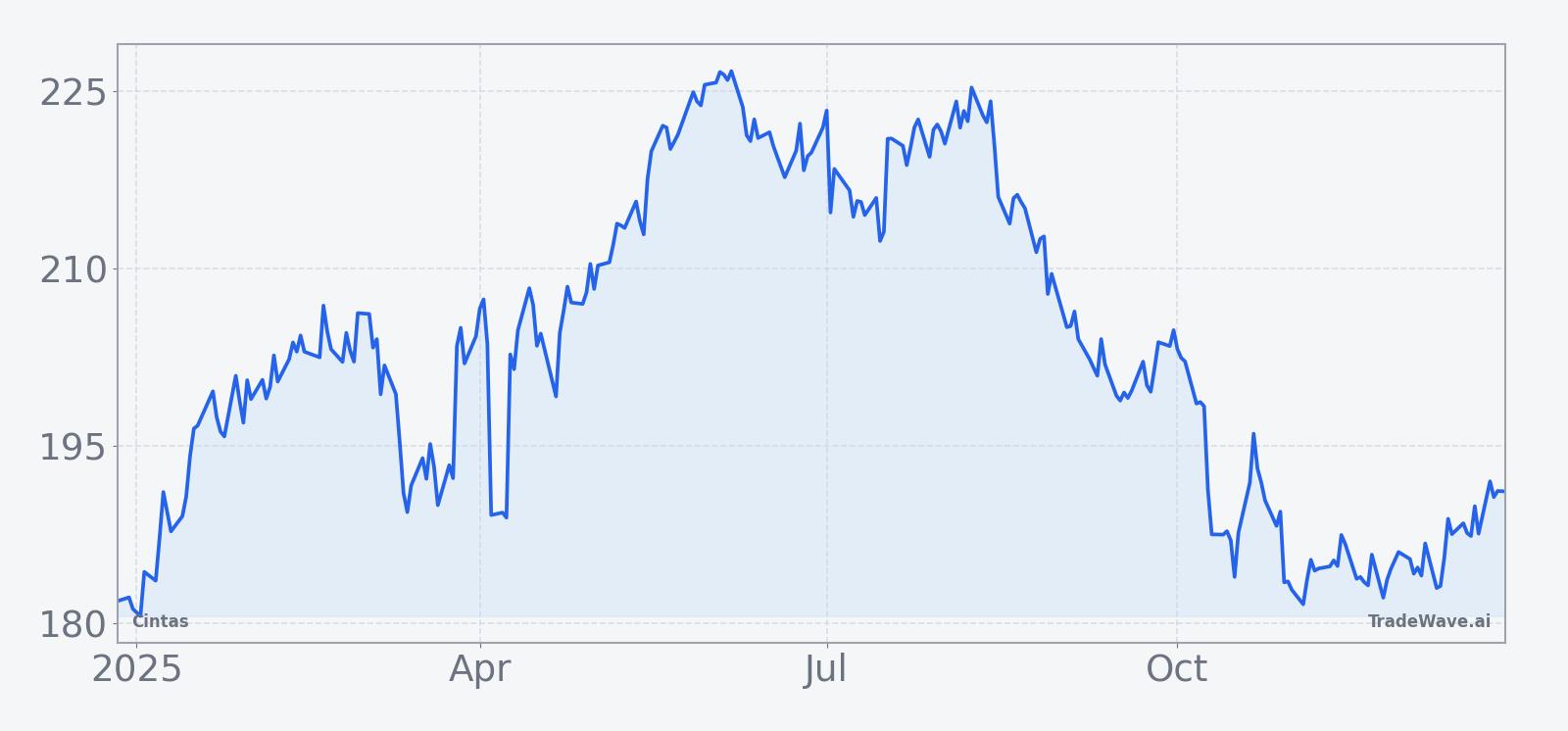
Cintas shares last changed hands at $192, up 2.36% on the day, although the available data does not specify how that level compares with the stock’s 52-week high, 52-week low or year-to-date performance. The move comes as investors continue to digest the company’s $5.2 billion bid for rival uniform provider UniFirst, a deal that includes a sizable break fee to address regulatory concerns and could reshape competitive dynamics in the sector if it ultimately gains approval.[2][3]
The UniFirst proposal follows a long history of Cintas using acquisitions to expand its footprint in uniforms, facility services and safety offerings, and the latest offer signals management’s willingness to push for consolidation even after prior attempts met resistance.[2] A successful transaction could bring scale benefits and broader customer reach, but it also raises questions about integration risk, antitrust scrutiny and potential divestitures, all of which could influence how the stock trades inside the current seasonal window.
Looking ahead, the next scheduled fundamental catalyst in the provided data is Cintas’s fiscal first-quarter 2026 earnings report, expected on Sep 24, 2025, with consensus forecasts calling for earnings of $1.20 per share on $2.70 billion in revenue, representing 7% earnings growth and an 8% sales increase year over year.[1] That report would land well inside the ongoing seasonal regime, giving investors a concrete checkpoint to test whether the historical pattern of constructive returns in the year after the presidential election is aligning with the company’s actual growth trajectory.
The chart below situates the latest move in its recent multi-month context.
Macro and policy backdrop
The year after a presidential election is often characterized by a shift from campaign rhetoric to concrete policy implementation, with implications for business spending and labor markets that matter for a services-heavy company like Cintas. While the provided macro data does not specify current readings on inflation, interest rates or employment, the broader pattern in recent cycles has been one of companies reassessing capital and operating budgets as new regulations, tax policies and spending priorities come into focus.
For Cintas, which supplies uniforms and facility services to a wide range of industries, that environment can influence both volume and pricing. Stronger employment and business formation typically support demand for its offerings, while tighter labor markets and higher wage costs can pressure margins but also increase the value of outsourced services. The historical strength of this year-after-the-election window suggests that, across past cycles, investors have often looked through near-term noise to a more stable demand picture as the policy agenda settles.
At the same time, the looming transition toward the midterm-election year has its own seasonal tendencies in markets, with investors frequently refocusing on fiscal debates, regulatory oversight and potential shifts in congressional control. For a consolidator like Cintas, that can affect the perceived odds of deal approvals and the regulatory tone around competition, which in turn may interact with the stock’s established seasonal pattern.
What to watch
For traders and longer-term investors tracking this window, one focal point will be how Cintas trades around key policy and economic updates as the year-after-the-election phase concludes and the midterm-election year begins. Sustained strength into and through those events would be consistent with the historical pattern of positive returns, while a failure to hold gains after adverse moves similar to the 21.82% intraperiod drawdown seen in 2021 would signal a departure from prior behavior.
Deal headlines around the UniFirst bid are another key variable, particularly any indications from regulators or the companies on timing, conditions or potential remedies.[2][3] A clearer path to approval could reinforce the constructive seasonal backdrop by bolstering the growth and synergy narrative, whereas heightened antitrust pushback or a breakdown in negotiations might test investor confidence during a window that has historically rewarded patience through volatility.
Investors may also want to monitor how the stock behaves as it approaches the Sep 24, 2025 earnings report, given that the forecasted 7% earnings and 8% revenue growth would, if realized, align with the kind of steady expansion that has underpinned prior strong years in this pattern.[1] Price action around that release, especially whether any initial reaction is followed by renewed trend in the trade direction of the seasonal window, will offer a real-time check on how closely the current cycle is tracking the historical template.
Ultimately, the combination of a long, historically profitable seasonal regime, an active M&A storyline and an approaching earnings catalyst gives market participants several concrete markers to watch. How Cintas trades around policy developments, regulatory signals on its UniFirst bid and its next earnings update will help determine whether this year-after-the-election window continues to resemble its past or begins to carve out a different path.