AI Memory Shortage Fuels Micron Technology (MU) Rally as HBM Supply Sells Out Into 2026
Micron Technology is moving through a late post-election-year stretch that has often favored gains just as AI-driven demand, record earnings and heavy options activity keep the stock in focus.

Key takeaways
- Micron Technology is in a 12-day seasonal window that has historically been strongly positive for the stock in the year after the presidential election.
- The pattern has been profitable in 90% of years, with 9 winners and 1 loser across the post-election-year sample.
- Average gains in winning years have been 9.13%, while the all-years average, including the lone losing year, is 8%.
- Intraperiod swings have featured sizable rallies and manageable drawdowns, with maximum favorable moves often in the low- to mid-teens and typical worst drawdowns in the low single digits.
- The window coincides with Micron’s powerful AI-driven run and follows record Q1 FY26 results and upbeat guidance, which have already pushed the stock sharply higher this year.[2][6]
- Unusual options volume and a surge in trading activity underline how closely traders are watching this stretch for confirmation or rejection of the historical pattern.[3][6][13]
According to historical data from TradeWave.ai, this late post-election-year period has shown a distinct tendency for Micron to trend higher over a compact 12-day span. The next section looks at how that pattern has behaved across prior cycles and how it frames the current backdrop.
Seasonal window
This seasonal window is currently underway, spanning 12 days, and has historically been a strong stretch for Micron Technology in the year after the presidential election. Today the stock trades at $248.55 after a powerful 180% gain year to date, leaving it about 6.1% below its recent 52-week high of $264.75.[6] Recent trading has also featured options volume running at roughly five times normal levels and a 139% jump in share turnover, signaling that positioning around this period is unusually active.[3][6][13] The combination of a historically supportive window, an extended AI-driven rally and intense derivatives activity gives this short phase outsized potential to either reinforce or challenge the prevailing bullish narrative.
The analysis groups Micron’s behavior by the presidential election cycle, focusing on years that match the current backdrop: the year after the presidential election, now concluding as December draws to a close. Grouping by this cycle matters because policy, fiscal stance and regulatory priorities often shift meaningfully in the first year of a new administration, which can influence capital spending plans for data centers and AI infrastructure and, in turn, demand for memory and high-bandwidth products.

Historically, this long-biased pattern has been skewed toward gains: 9 winning years against just 1 losing year, with winners averaging a 9.13% advance and the all-years average, including the down year, at 8%. The median outcome of 9.93% underscores how clustered the positive results have been, while a Sharpe ratio of 1.54 points to a favorable balance between return and volatility based on end-of-window outcomes.
Looking at individual years, the strongest performance in this sample came in 1993, when Micron gained 13.21% over the window, with a best intraperiod run-up of 13.48% and a worst drawdown of 3.77% from the entry level. The weakest year was 1989, which delivered a 1.26% loss despite a maximum favorable move of 5.07% and a maximum adverse move of 3.79%, illustrating that even in the lone losing case the stock still experienced a notable rally before fading.
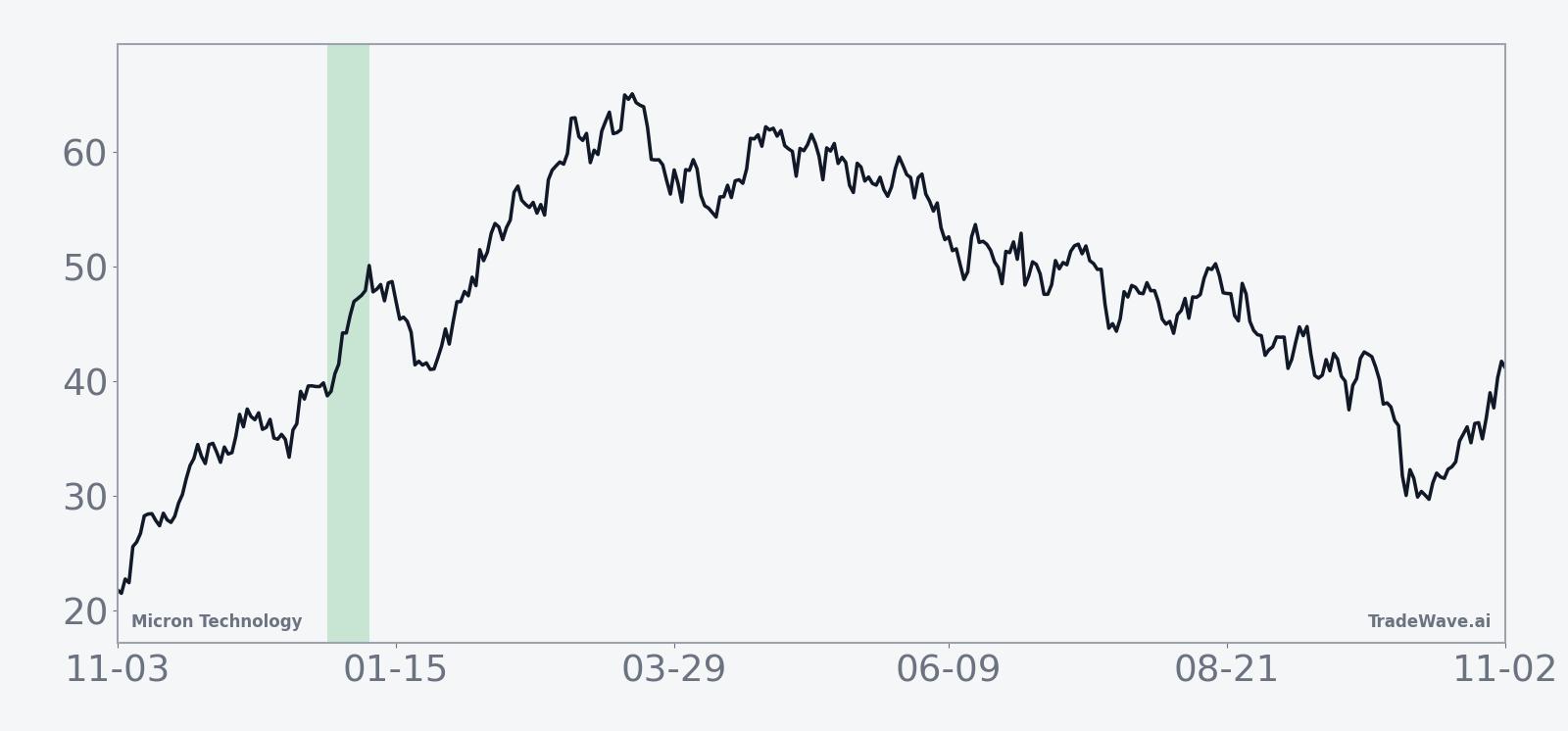
The historical seasonal average trend for this window shows Micron typically grinding higher through most of the 12-day span, with gains accruing relatively steadily rather than in a single spike. That profile suggests that in prior cycles, strength has tended to build across the window, with only modest mid-period pauses before the pattern reaches its typical peak toward the end of the stretch.
A combined view of yearly net results and intraperiod swings highlights how upside and downside have interacted within this window.

The stacked bar view of net returns alongside maximum favorable and adverse excursions shows that in most years Micron has enjoyed double-digit peak rallies within the window while keeping worst drawdowns in the low- to mid-single digits. That combination of sizable upside potential and contained downside has contributed to a TradeWave Ratio of 2.78, indicating that price has typically traveled meaningfully in the trade direction during this period even when the final close did not capture the full move.
History does not guarantee future results; adverse excursions (MAE) can be large even in winning windows.
Taken together, the historical pattern defines the quantitative seasonal backdrop for the current period.
Price and near-term drivers
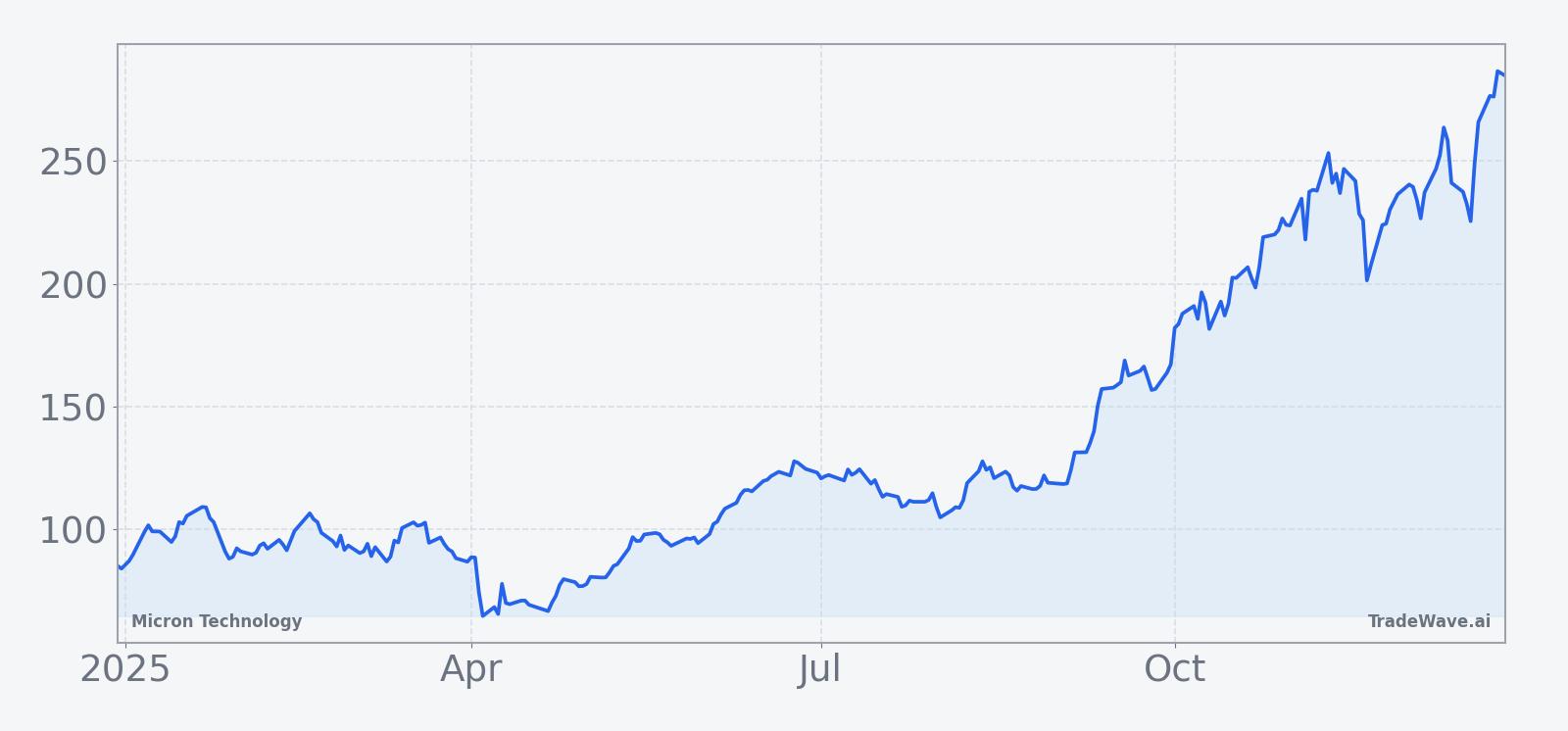
Micron’s seasonal backdrop arrives as the stock trades near record territory after a year of outsized gains, powered by AI-related demand and a sharp recovery in the memory market.[1][2][6] The company’s most recent quarter, reported on Dec 17, delivered record Q1 FY26 revenue of $13.6 billion, up 57% from a year earlier and ahead of the $13.0 billion consensus, with management pointing to strong demand for high-bandwidth memory used in AI workloads.[6] Micron also guided for Q2 revenue of $18.7 billion, significantly above earlier expectations, reinforcing the view that 2026 supply is effectively spoken for in key product lines.[2][6]
Sector conditions have turned decisively more favorable after a prolonged downturn, with pricing power improving across DRAM and NAND as supply-demand balance tightens.[1] Within that backdrop, Micron has emerged as a prime beneficiary of the AI build-out, particularly as Nvidia’s next-generation Rubin platform is expected to incorporate 288 GB of HBM4 DRAM, roughly 50% more than the current Blackwell architecture, a shift that analysts expect to support Micron’s gross margins at around 70% on these products.[2] That combination of cyclical recovery and structural AI demand has helped justify aggressive price-target revisions, with a consensus target around $300 per share from analysts tracked by Yahoo Finance, who broadly rate the stock a Buy.[1]
Trading behavior has reflected that enthusiasm. Recent sessions saw total options volume surge to roughly five times normal levels, with 260,000 calls and 213,000 puts changing hands, while share volume jumped to 63.9 million, a 139% increase over the three-month average.[3][6][13] Short interest remains relatively modest at 2.96%, suggesting that while some investors are betting against the rally, the stock is not heavily crowded on the short side.[3] For a name that sits at the center of the AI hardware build-out, that mix of strong fundamentals, elevated derivatives activity and moderate short positioning sets the stage for potentially sharp moves when new information hits.
The chart below situates the latest move in its recent multi-month context.
Macro and policy backdrop
The current window also sits against a broader macro narrative in which AI infrastructure spending has become a key growth driver for the semiconductor complex.[2][6] As hyperscale cloud providers and large enterprises race to deploy AI capabilities, demand for high-bandwidth memory and advanced DRAM has tightened supply, with reports that Micron’s 2026 HBM capacity is already largely booked.[6] That environment has allowed memory producers to regain pricing power after years of oversupply, supporting higher margins and more stable earnings trajectories.[1]
From a policy perspective, the year after the presidential election often features a mix of new regulatory initiatives and spending priorities that can influence capital expenditure plans. For AI and semiconductor infrastructure, that can include incentives for domestic manufacturing, export controls on advanced chips and potential scrutiny of data-center energy use. While the TradeWave pattern aggregates across many such cycles rather than predicting any single administration’s choices, it captures how investors have historically navigated this blend of policy uncertainty and growth optimism in the first year of a term.
What to watch
For this 12-day window, traders will be watching whether Micron continues to respect the historical tendency for steady gains or instead stalls after a powerful year-long run. On the fundamental side, any updates on AI-related demand, HBM supply constraints or pricing trends in DRAM and NAND could quickly influence expectations for the company’s elevated Q2 revenue guidance.[1][2][6] Price-wise, the zone around the recent 52-week high near $264.75 is a natural reference point; behavior as the stock approaches or tests that area will help indicate whether the seasonal pattern is reinforcing the uptrend or giving way to consolidation.
Options and volume signals will also be important to monitor. If the recent spike in options activity and trading volume persists or builds, it would suggest that institutional and retail traders are continuing to position aggressively around Micron’s AI story during this historically strong stretch.[3][6][13] A sharp fade in activity, by contrast, could hint that the latest leg of the rally is losing sponsorship even as the seasonal window remains statistically favorable. Finally, any meaningful shift in short interest from the current 2.96% level would offer another read on whether skeptics are leaning more heavily into the name or backing away as the pattern plays out.[3]
Sources
- [1] Yahoo Finance, "Analysts Lift Micron Price Targets Ahead of Quarterly Earnings" (Dec 17, 2025).
- [2] Yahoo Finance, "Micron Earnings Boost Expected as Nvidia Expands HBM Usage" (Mar 20, 2025).
- [3] Seeking Alpha, "Micron stock jumps after raising Q4 guidance" (Aug 11, 2025).
- [6] Forbes, "Why Did Micron Stock Jump 10% Yesterday?" (Dec 19, 2025).
- [13] Forbes, options and volume context cited within "Why Did Micron Stock Jump 10% Yesterday?" (Dec 19, 2025).