Geopolitical Tensions Keep Defense Spending Elevated for Northrop Grumman (NOC)
Northrop Grumman is stepping into a historically favorable 73-day pattern as its shares sit near record territory after a year of robust defense demand and upgraded profit guidance.
Key takeaways
- A 73-day seasonal window for Northrop Grumman that begins on Dec 26 in years after U.S. presidential elections has historically been strongly positive for the stock.
- The pattern has been profitable in 100% of the 10 historical years in this election-cycle phase, with 10 winners and 0 losers and an average gain of 10.32%.
- The trade direction is long, supported by a Sharpe ratio of 2.41 and a TradeWave Ratio of 2.26, indicating historically favorable risk-adjusted and directional behavior.
- Intraperiod swings have been meaningful, with some years showing double-digit peak run-ups and notable drawdowns before finishing higher.
- The window occurs as Northrop Grumman trades about 32% higher year to date, helped by raised profit guidance and strong demand for defense systems.[3][4]
- Investors will be watching how this late “year after the presidential election” pattern transitions into the midterm election year, when policy and budget debates can shift defense spending expectations.[3]
According to historical data from TradeWave.ai, this late post-election stretch has shown a distinct seasonal character for Northrop Grumman. The next section looks at how that pattern has behaved across prior cycles and what it implies for the current backdrop.
Seasonal window
This seasonal window is currently underway, spanning 73 days, and has historically been a strong stretch for Northrop Grumman in the year after the presidential election. The stock enters this regime around $621.63, up about 32% so far in 2025, leaving it near the upper end of its recent trading history even without precise 52-week levels disclosed.[3][4]
Grouping the data by the presidential election cycle matters because defense spending and contract visibility often track multi-year budget frameworks that are closely tied to who controls the White House and Congress. The year after the presidential election is typically a digestion phase in Washington, when new priorities are translated into detailed appropriations, and this can create recurring patterns in how defense primes trade as funding lines for aircraft, missile defense and classified programs are clarified.[3][4]
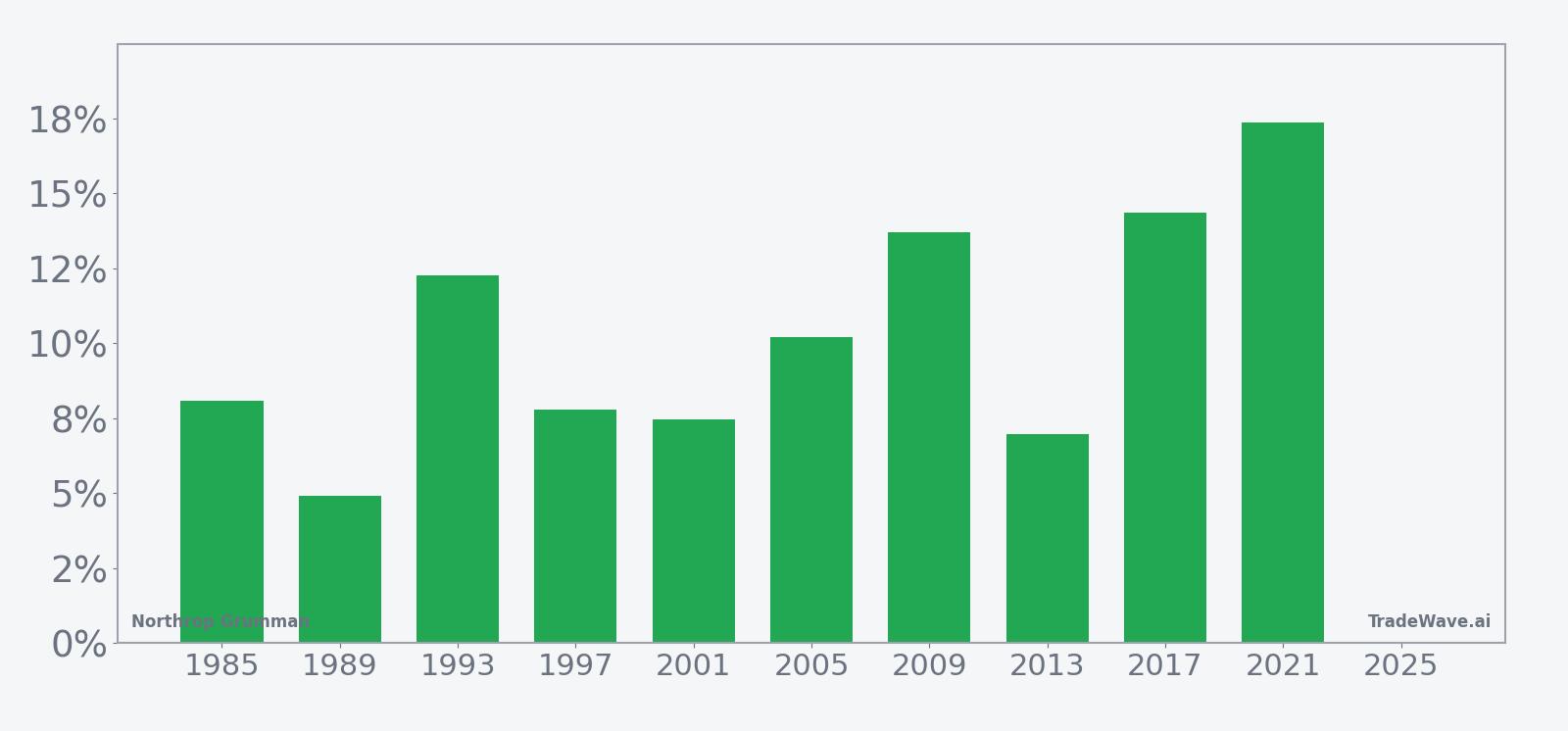
Historically, this long-biased pattern has been unusually consistent: all 10 years in the sample finished higher over the 73-day span, with an average gain of 10.32% and a median outcome of 9.14%. The strongest year in the set was 2021, when Northrop Grumman advanced 17.38% during the window, while the softest gain still came in at 4.93% in 1989, underscoring that even the weaker instances have been positive.
The intraperiod behavior has not been one-way. Maximum favorable excursions, or the best point-to-peak moves within the window, have reached as high as 28.26% in 2021 and 27.52% in 1997, showing that rallies can extend well beyond the final closing gain. At the same time, maximum adverse excursions, or the worst drawdowns from the entry, have occasionally been deep, including a roughly 12.71% dip in 1985 and drawdowns of around 9.49% in 1989, before the stock ultimately recovered to finish the window in positive territory.
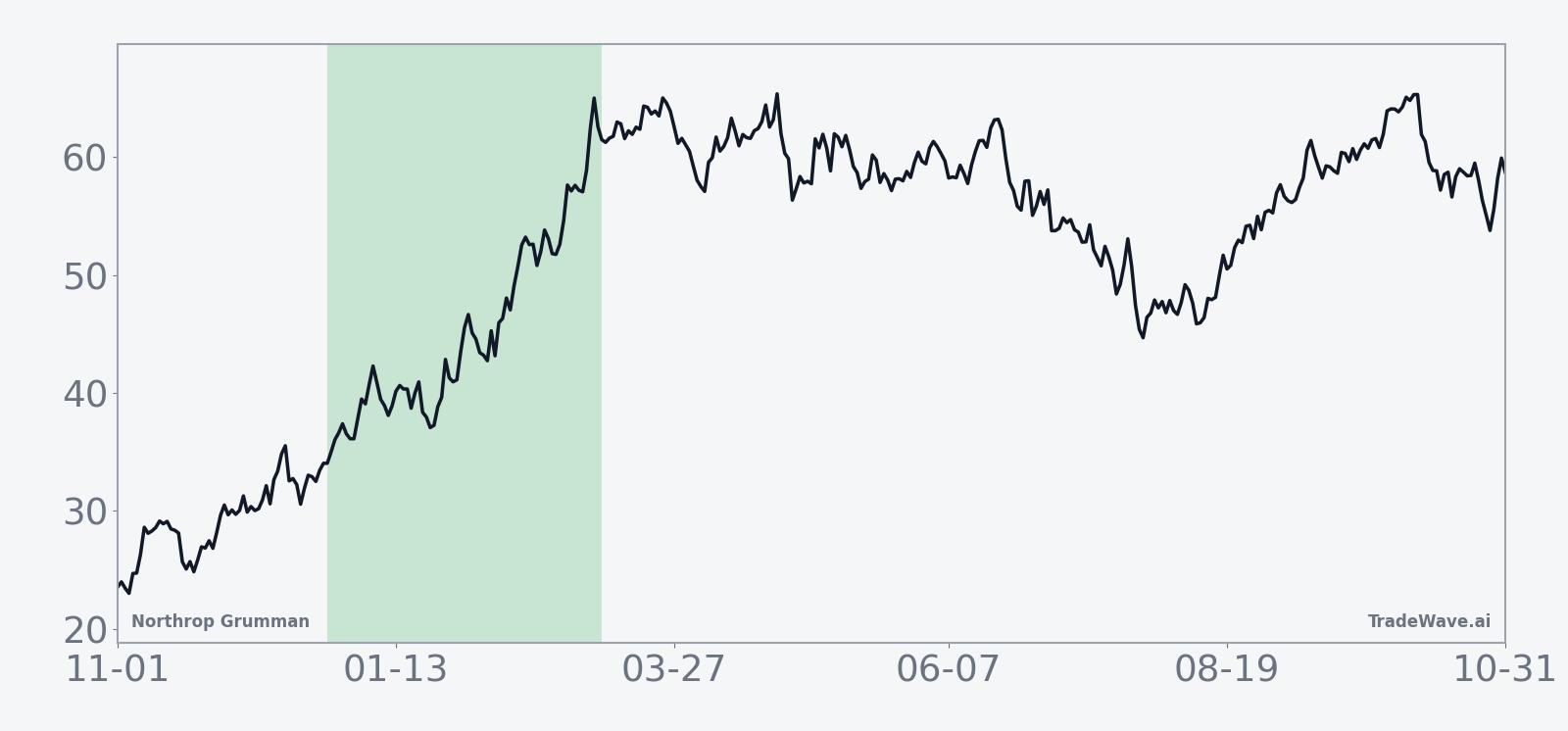
The historical seasonal trend chart suggests that gains have tended to build relatively steadily across the window rather than arriving in a single burst, with a bias toward continued strength into the later stages of the period. That pattern is consistent with a backdrop in which budget clarity and contract news accumulate as the post-election policy agenda moves from rhetoric to implementation.
A second view that combines net results with peak run-ups and worst drawdowns highlights how upside and downside have coexisted within this otherwise strong pattern.
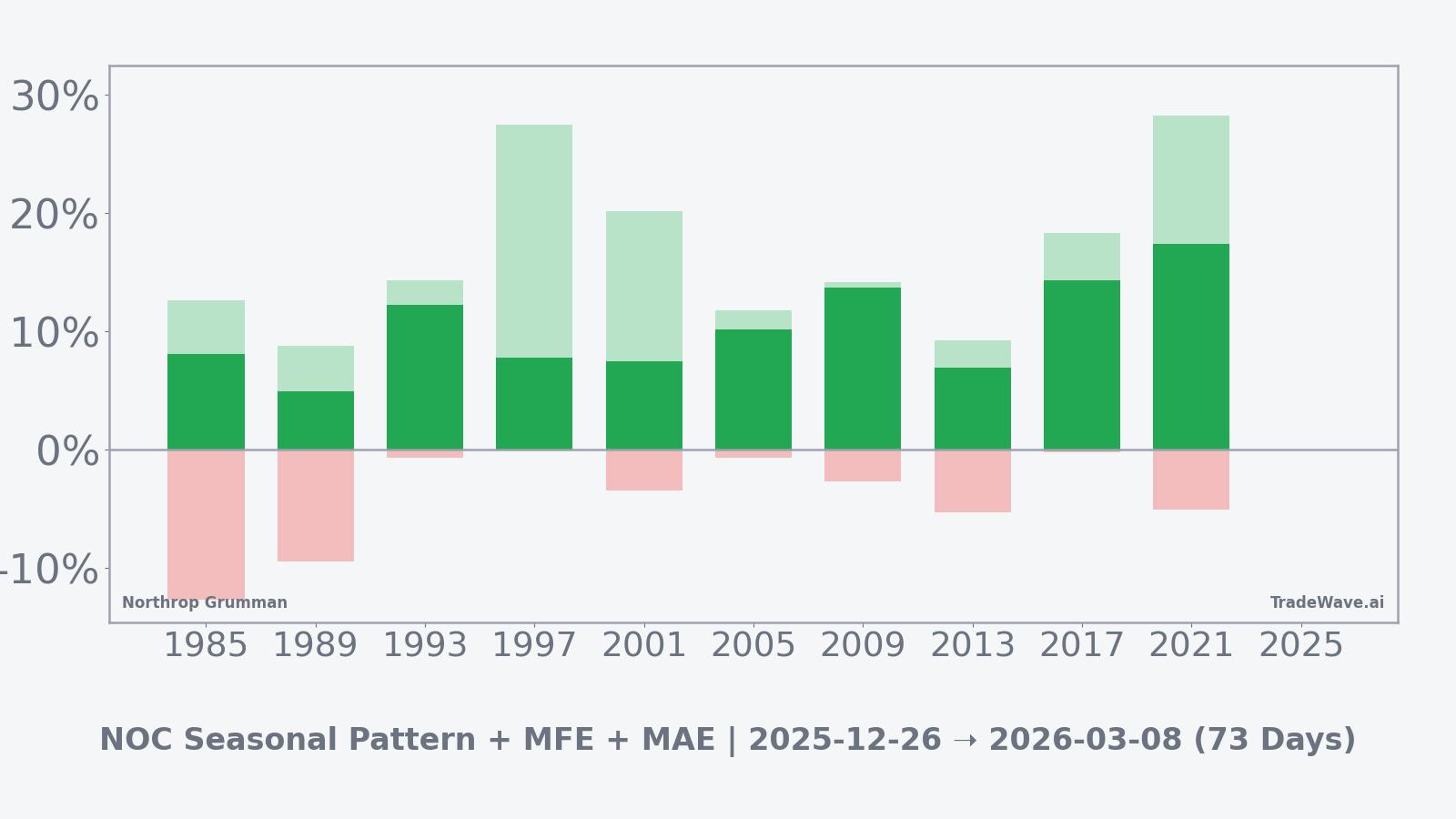
The combined net, peak-run-up and drawdown bars show that while every year in the sample ended higher, several saw sizable swings along the way, with double-digit upside potential often paired with mid-single to low-double-digit downside at some point in the window. Taken together, the historical pattern defines the quantitative seasonal backdrop for the current period.
History does not guarantee future results, and adverse excursions can be large even in winning windows.
Price and near-term drivers
Northrop Grumman shares last traded around $621.63 on Dec 26, down about 1.07% on the day but still up roughly 32% for 2025, reflecting a strong run that has pushed the stock toward the upper end of its recent range.[3][4] The move caps a year in which the defense contractor raised its 2025 adjusted profit forecast to $25.65 to $26.05 per share, even as it slightly trimmed its sales outlook to $41.7 billion to $41.9 billion, signaling confidence in margins despite some top-line pressure.[4]
The chart below situates the latest move in its recent multi-month context.
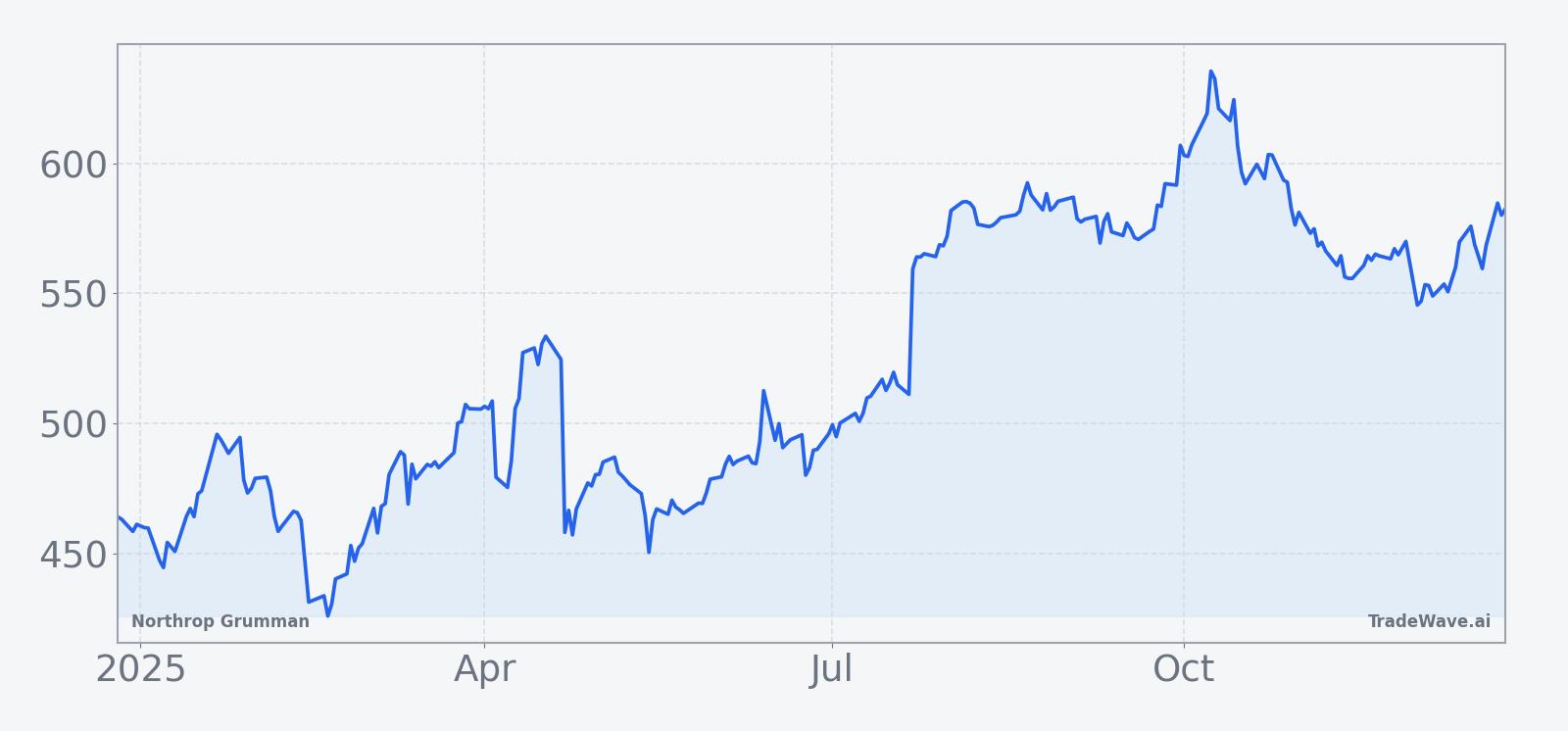
Fundamentally, the company has benefited from sustained demand for weapons and military aircraft as geopolitical tensions remain elevated, supporting upgrades to its profit forecast earlier in the year.[3][4] Recent quarterly results underscored that trend: Northrop reported Q3 2025 earnings of $7.67 per share on revenue of $10.42 billion, ahead of consensus estimates, following a Q2 in which sales also topped expectations and net income reached $1.17 billion, or $8.15 per share.[2][4]
Analysts have generally leaned constructive on the name, with Deutsche Bank highlighting Northrop as a defense giant whose long-term prospects are improving and assigning a consensus price target around $700, implying room above current levels if execution and demand trends hold.[1] Part of that optimism rests on multi-year programs such as the B-21 Raider stealth bomber, which is expected to transition from cash losses to profit around 2029 to 2030, potentially boosting free cash flow growth beyond 2028 as production scales and learning-curve benefits accrue.[1]
At the sector level, defense contractors have been supported by a combination of strong order books and expectations for continued spending on missile defense, aircraft and advanced systems, including potential contracts such as the Golden Dome missile defense system.[4][5] That demand has been tempered by lingering supply chain disruptions tied to the pandemic and trade frictions, which have pressured production capabilities and delivery schedules across aerospace and defense, though Northrop has so far managed to grow sales and lift profit guidance despite those headwinds.[3][4]
Macro and policy backdrop
The current seasonal window arrives as the U.S. policy cycle transitions from the year after the presidential election toward the midterm election year, a period when debates over deficits, defense priorities and foreign policy can intensify. Historically, the year after the election has been a time when new administrations or returning incumbents translate campaign themes into concrete budget proposals, which then filter into multi-year defense authorizations and appropriations that shape revenue visibility for contractors like Northrop.[3]
Geopolitical tensions remain a central macro driver, with ongoing conflicts and regional flashpoints sustaining demand for advanced weapons, surveillance and missile defense systems.[3] For Northrop, that environment supports its raised profit outlook and underpins expectations that programs such as the B-21 and other classified platforms will remain funding priorities, even as lawmakers debate broader fiscal constraints.[1][3][4]
Looking ahead, investors will be watching how the late post-election pattern for Northrop interacts with the early stages of the midterm election year, which has historically been more volatile for many sectors as markets digest shifting expectations for congressional control and potential changes to spending trajectories. For defense, that can mean periods of headline-driven swings around budget negotiations, even when the longer-term demand picture remains constructive.[3][5]
What to watch in this window
For this 73-day window, the key question is whether Northrop Grumman’s price action continues to resemble the historical pattern of steady gains punctuated by occasional drawdowns. Traders and longer-term investors alike will be monitoring how the stock behaves around any pullbacks: historically, even years with double-digit intraperiod declines have recovered to finish higher, but there is no assurance that this cycle will follow the same script.
On the fundamental side, progress on major programs such as the B-21 Raider and any updates on missile defense or classified contracts could influence sentiment, particularly if they alter expectations for free cash flow beyond 2028.[1][4] Policy developments will also matter, including early signals from budget negotiations and defense authorization debates as Washington moves from the year after the presidential election into the midterm year, a transition that has previously coincided with shifts in sector leadership.[3][5]
From a levels perspective, investors may focus on how the stock trades relative to its recent highs after a roughly 32% year-to-date advance, watching whether pullbacks remain contained or begin to resemble the deeper historical drawdowns seen in some prior windows.[3][4] Sustained strength on elevated volume into the latter part of the window would be more consistent with the historical seasonal tendency, while an inability to hold gains or a break of recent support could signal that macro or company-specific factors are overriding the pattern.
Ultimately, the seasonal record provides a structured backdrop rather than a forecast. The coming weeks will test whether Northrop Grumman’s combination of strong fundamentals, elevated starting point and a historically favorable post-election window can coexist with the policy and geopolitical uncertainties that typically accompany the run-up to a midterm election year.
Sources
- [1] CNBC, “Buy this defense giant as its long-term prospects improve, says Deutsche Bank” (Oct 8, 2025)
- [2] CNBC, “Stocks making the biggest moves premarket: GM, Coca-Cola, 3M, Philip Morris & more” (Oct 21, 2025)
- [3] Reuters, “Northrop Grumman lifts 2025 profit forecast on strong demand for weapons” (Jul 22, 2025)
- [4] Reuters, “Northrop raises annual profit forecast on strong demand” (Oct 21, 2025)
- [5] Seeking Alpha, “SA Roundtable: Are defense stocks a buy, and if so, which ones?” (Aug 9, 2025)